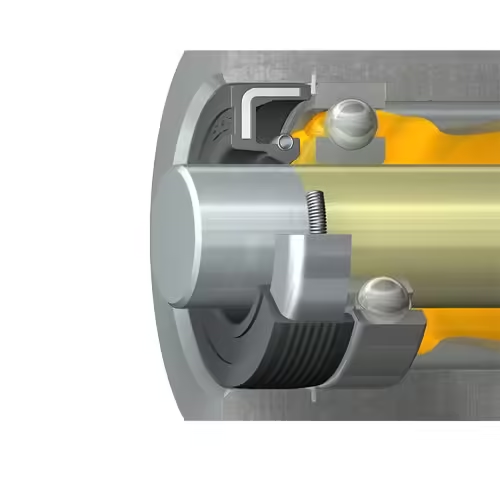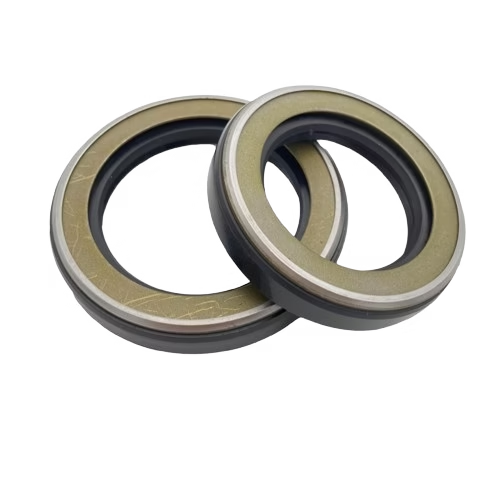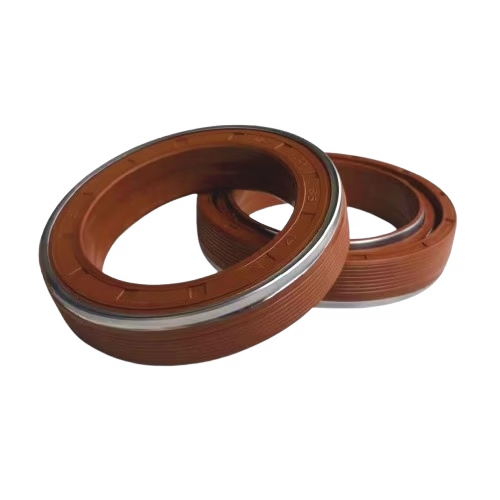
Choosing the right hydraulic cylinder seal kit materials is not only about matching size. In real hydraulic applications, material selection affects leakage control, wear life, pressure resistance, friction, fluid compatibility, and maintenance cost.
A complete hydraulic cylinder seal kit may include rod seals, piston seals, wipers, O-rings, backup rings, wear rings, buffer seals, and static seals. These parts often use different materials because each position faces different pressure, movement, friction, contamination, and temperature conditions.
For buyers, OEM engineers, distributors, and repair companies, the key question is not simply “Which material is best?” The better question is: Which material combination matches the hydraulic cylinder design and working conditions?
Quick Answer: Which Material Is Best for Hydraulic Cylinder Seal Kits?
There is no single best material for every hydraulic cylinder seal kit. For most standard mineral oil hydraulic cylinders, PU is commonly used for rod seals, piston seals, and wipers because it offers good wear resistance and extrusion resistance. NBR is widely used for O-rings and static seals because it provides good oil resistance and cost efficiency.
For high-temperature or aggressive fluid applications, FKM or PTFE-based seals may be required. For guiding and side-load control, POM, nylon, PTFE bronze, or phenolic wear rings are commonly used.
In most applications, the best solution is a material combination, not one universal material.
Application-Based Hydraulic Cylinder Seal Kit Material Overview
| Application Type | Recommended Material Combination | Main Reason |
|---|---|---|
| Standard hydraulic cylinder | PU dynamic seals + NBR O-rings + POM wear rings | Cost-effective and reliable |
| Excavator / construction machinery | PU rod seals + PU wipers + reinforced wear rings | Wear and contamination resistance |
| High-temperature cylinder | FKM / PTFE seals + suitable backup rings | Better heat resistance |
| Low-friction precision cylinder | PTFE seals + NBR or FKM energizers | Reduced stick-slip |
| Chemical or special fluid system | FKM / EPDM / PTFE depending on media | Fluid compatibility |
| Heavy side-load cylinder | Phenolic / PTFE bronze / POM wear rings | Guiding and support |
This table gives buyers a quick starting point. Final material selection still depends on pressure, temperature, hydraulic fluid, speed, groove design, rod condition, and failure risk.
What Materials Are Used in a Hydraulic Cylinder Seal Kit?
A hydraulic cylinder seal kit is a sealing system, not a single rubber part. Each component has a different function.
Typical Components in a Hydraulic Cylinder Seal Kit
Common parts include:
- Rod seal
- Piston seal
- Wiper seal or dust seal
- O-rings
- Backup rings
- Wear rings or guide rings
- Buffer seals
- Static seals
A small forklift cylinder may use a simple kit, while an excavator, hydraulic press, or heavy industrial cylinder may require multiple sealing and guiding elements.
Why One Seal Kit Uses Multiple Materials
Different sealing positions face different working conditions.
A rod seal must resist oil pressure, sliding wear, and rod movement. A piston seal must separate pressure chambers inside the cylinder. A wiper must remove dust, mud, water, and external contamination. An O-ring may only seal a static groove, but it may need a backup ring if pressure or clearance is high.
Wear rings do not seal oil directly, but they protect the sealing system by guiding movement and reducing side load.
Hydraulic Cylinder Seal Kit Components and Common Materials
| Seal Kit Component | Common Materials | Main Function |
|---|---|---|
| Rod seal | PU, PTFE, NBR, fabric rubber | Prevent internal fluid leakage along the rod |
| Piston seal | PU, PTFE, NBR, fabric rubber | Separate pressure chambers inside the cylinder |
| Wiper seal | PU, NBR | Remove dust, mud, water, and contamination |
| O-ring | NBR, FKM, EPDM | Static sealing or energizing other seals |
| Backup ring | PTFE, POM, nylon | Prevent extrusion under pressure |
| Wear ring | POM, nylon, PTFE bronze, phenolic fabric | Guide piston and rod movement |
| Buffer seal | PU, PTFE, NBR | Reduce pressure shock before the rod seal |
| Static seal | NBR, FKM, PU | Seal gland, cap, or fixed housing areas |
Key Material Properties Buyers Should Compare
When comparing hydraulic cylinder seal kit materials, buyers should look beyond dimensions and price. The following properties directly affect seal life and leakage control.
Pressure Resistance
Hydraulic cylinders may face high pressure and pressure spikes during lifting, pressing, braking, or impact. If the seal material is too soft or the groove clearance is too large, the material can be forced into the clearance gap. This is extrusion damage.
PU, fabric-reinforced rubber, and properly designed PTFE seals are often selected where extrusion resistance is important. O-rings may need backup rings in high-pressure grooves.
Temperature Range
Temperature affects hardness, flexibility, compression set, and aging.
At low temperature, some rubber materials become hard and lose elasticity. At high temperature, some materials soften, crack, or lose sealing force. Continuous oil temperature is more important than short peak temperature when evaluating service life.
For high-temperature hydraulic systems, FKM or PTFE may be more suitable than standard NBR or standard PU.
Wear Resistance and Service Life
Dynamic seals slide against the rod or bore surface. A material with poor wear resistance may leak quickly even if the size is correct.
Wear life is affected by:
- Rod surface condition
- Bore condition
- Lubrication
- Dust and mud contamination
- Side load
- Stroke frequency
- Seal hardness
- Seal lip design
PU is widely used in dynamic hydraulic sealing positions because it provides strong wear resistance in many standard and heavy-duty hydraulic applications.
Hydraulic Fluid Compatibility
Most standard hydraulic cylinders use mineral oil-based hydraulic fluid, but some systems use synthetic fluids, water-glycol fluids, bio-based oils, fire-resistant fluids, fuel, or chemical media.
Wrong fluid compatibility can cause swelling, shrinking, hardening, cracking, softening, or loss of sealing force. Buyers should provide the exact hydraulic fluid type when the medium is not standard mineral oil.
Friction and Stick-Slip Behavior
In precision hydraulic systems, friction can affect movement stability. Excessive friction may cause stick-slip, vibration, slow response, or poor positioning accuracy.
PTFE-based seals are often used when low friction is required. However, PTFE has lower elasticity than rubber, so it usually requires an O-ring or spring energizer and more accurate groove design.
PU Hydraulic Cylinder Seal Kit Materials
Polyurethane, commonly called PU, is one of the most common materials for hydraulic cylinder seal kits. It is especially common for rod seals, piston seals, and wipers.
Main Advantages of PU Seals
PU provides a practical balance of wear resistance, pressure resistance, flexibility, and cost.
Main advantages include:
- Good wear resistance
- Good extrusion resistance
- Suitable for many high-pressure hydraulic applications
- Good service life in dynamic sealing positions
- Strong performance for rod seals, piston seals, and wipers
- Suitable for construction and mobile machinery
For excavators, forklifts, loaders, agricultural machinery, and industrial cylinders, PU is often the first material to consider for dynamic seals.
Common Limitations of PU
PU is not suitable for every condition.
Possible limitations include:
- Not ideal for very high-temperature environments
- Hydrolysis risk in some humid or water-based conditions
- Performance depends on PU grade
- Not suitable for all chemicals or special hydraulic fluids
Buyers should not only ask whether the seal is “PU.” Different PU compounds may have different temperature resistance, hardness, wear behavior, and fluid compatibility.
Best Applications for PU Seal Kits
PU is commonly used in:
- Excavators
- Forklifts
- Loaders
- Agricultural machinery
- Construction equipment
- Standard industrial hydraulic cylinders
- Hydraulic repair kits
- Mobile hydraulic systems
NBR Hydraulic Cylinder Seal Kit Materials
NBR, also called nitrile rubber, is widely used in industrial sealing. In hydraulic cylinder seal kits, NBR is commonly used for O-rings, static seals, energizers, and some low-demand sealing positions.
Main Advantages of NBR
NBR performs well in many mineral oil hydraulic systems and is cost-effective for standard seal kits.
Main advantages include:
- Good resistance to mineral hydraulic oil
- Lower material cost
- Easy availability
- Suitable for O-rings and static seals
- Useful as an energizer for PTFE or PU designs
- Practical for standard hydraulic systems
For distributors and repair companies, NBR O-rings are common stock items because they cover many standard hydraulic sealing needs.
Common Limitations of NBR
NBR is not normally the best material for heavy dynamic sealing positions.
Limitations include:
- Lower wear resistance than PU
- Limited high-temperature performance
- Poor resistance to many aggressive chemicals
- Aging risk under ozone, sunlight, or outdoor exposure
- Not suitable for every synthetic or fire-resistant fluid
Using NBR only because it is cheaper may lead to shorter service life in high-pressure or dirty working conditions.
Best Applications for NBR Seal Kit Components
NBR is commonly used for:
- O-rings
- Static seals
- Energizers
- Standard hydraulic oil systems
- Cost-sensitive replacement kits
- Support sealing positions
For rod and piston seals, NBR should only be selected when pressure, movement, and wear requirements are suitable.
FKM Hydraulic Cylinder Seal Kit Materials
FKM, also known as fluoroelastomer, is selected when heat, oil resistance, chemical exposure, aging resistance, or fuel exposure is more demanding than standard NBR can handle.
Main Advantages of FKM
FKM offers better resistance to high temperature and many oils, fuels, and chemicals.
Main advantages include:
- Better high-temperature resistance than NBR
- Strong resistance to many oils and fuels
- Good chemical resistance in many industrial environments
- Better aging, ozone, and weathering resistance
- Suitable for demanding static sealing positions
Common Limitations of FKM
FKM is more expensive than NBR and is not always necessary for standard hydraulic oil systems.
Limitations include:
- Higher material cost
- Lower low-temperature flexibility than some alternatives
- Not always required for standard mineral oil cylinders
- Not the first choice for high-wear dynamic sealing unless specially designed
- Compatibility limitations with some fluids
FKM should be selected based on heat and chemical requirements, not simply because it is a higher-grade material.
Best Applications for FKM in Hydraulic Cylinder Seal Kits
FKM is commonly used for:
- High-temperature hydraulic systems
- Cylinders near engines or heat sources
- Chemical processing equipment
- Fuel or special fluid exposure
- Industrial equipment with aging concerns
- Static seals requiring better heat resistance
PTFE Hydraulic Cylinder Seal Kit Materials
PTFE is not a rubber. It is a fluoropolymer used in hydraulic seals where low friction, chemical resistance, or high-temperature performance is required.
Main Advantages of PTFE
PTFE is useful for applications where movement stability and low friction matter.
Main advantages include:
- Very low friction
- Excellent chemical resistance
- Good high-temperature performance
- Good dimensional stability
- Suitable for precision hydraulic movement
- Useful for reducing stick-slip
- Often used with NBR or FKM energizers
PTFE can improve motion performance where rubber seals create too much friction.
Common Limitations of PTFE
PTFE has lower elasticity than rubber, so it often requires an energizer such as an O-ring or spring.
Limitations include:
- Lower elasticity than elastomers
- More precise groove design required
- More careful installation required
- Higher cost than standard rubber solutions
- Possible leakage if energizer design is incorrect
- Not ideal for badly scratched rods or poor housing conditions
PTFE is a strong material, but it is not a simple replacement for every PU or NBR seal.
Best Applications for PTFE Seal Kits
PTFE is suitable for:
- Precision hydraulic cylinders
- Low-friction systems
- High-speed movement
- Chemical fluid exposure
- High-temperature systems
- Applications requiring reduced stick-slip
- Cylinders with accurate groove and surface control
POM, Nylon, and Wear Ring Materials in Hydraulic Cylinder Seal Kits
Wear rings and guide rings are often overlooked during seal kit replacement, but they are critical for protecting the main seals.
Why Wear Rings Matter
Wear rings do not seal hydraulic oil directly. Their job is to guide the rod or piston and absorb side load.
If the wear ring is damaged or too soft, the rod or piston may contact the metal housing. This can damage the rod seal, piston seal, cylinder bore, and rod surface. In many repeated leakage cases, the root cause is not the main seal material but poor guiding or excessive clearance.
Common Wear Ring Materials
Common materials include:
- POM
- Nylon
- PTFE bronze
- Phenolic resin
- Fabric-reinforced composite materials
POM offers good strength and dimensional stability. Nylon is cost-effective for many standard guide positions. PTFE bronze provides lower friction and improved wear behavior. Phenolic fabric materials are often used in heavy-duty cylinders with higher side load.
Main Hydraulic Cylinder Seal Kit Materials Compared
| Material | Main Strengths | Limitations | Common Seal Kit Use |
|---|---|---|---|
| PU | High wear resistance, good extrusion resistance | Limited high-temperature performance; grade matters | Rod seals, piston seals, wipers |
| NBR | Good mineral oil resistance, low cost | Lower wear and heat resistance | O-rings, static seals, energizers |
| FKM | Heat resistance, chemical resistance, aging resistance | Higher cost; lower low-temperature flexibility | O-rings, special seals, high-temperature static seals |
| PTFE | Low friction, chemical resistance, high-temperature capability | Lower elasticity; precise design required | Rod seals, piston seals, backup rings |
| POM | High strength, good dimensional stability | Not a sealing rubber | Wear rings, guide rings |
| Nylon | Cost-effective guide material | Moisture absorption may matter by grade | Wear rings, guide rings |
| Fabric rubber | Heavy-duty strength, extrusion resistance | Higher friction than PTFE | Piston seals, industrial cylinders |
| EPDM | Suitable for some water-based fluids | Poor compatibility with mineral oil | Special fluid systems |
How Operating Conditions Affect Hydraulic Seal Kit Material Selection
Operating conditions should guide material selection. The table below gives a practical direction for buyers.
| Operating Condition | Common Material Direction | Key Buyer Check |
|---|---|---|
| Standard mineral oil cylinder | PU dynamic seals + NBR O-rings + POM wear rings | Size, pressure, temperature, rod condition |
| High pressure or pressure shock | PU, fabric-reinforced seals, backup rings | Groove clearance, hardness, pressure spikes |
| High temperature | FKM, PTFE, special PU grades | Continuous oil temperature and fluid type |
| Dust, mud, outdoor use | PU wipers, strong rod seals, reliable wear rings | Wiper lip design and rod surface |
| Chemical or special fluid | FKM, EPDM, PTFE depending on media | Exact fluid name and compatibility |
| Low friction or precision motion | PTFE-based seals | Surface finish, groove accuracy, energizer |
| Heavy side load | POM, PTFE bronze, phenolic wear rings | Guide clearance and load direction |
This section should be used as a screening guide. Final confirmation still depends on the cylinder drawing, seal profile, groove dimensions, hydraulic fluid, and working environment.
Common Material Selection Mistakes Buyers Should Avoid
Choosing Only by Size Instead of Material
Two seals can have the same dimensions but completely different compounds. A seal made from standard NBR may fit the groove but fail quickly if the original design required PU or PTFE.
For replacement kits, buyers should confirm material, hardness, seal profile, pressure, temperature, hydraulic fluid, and application equipment.
Replacing PU with NBR in Dynamic Sealing Positions
NBR may be cheaper, but replacing a PU dynamic seal with NBR can reduce service life under sliding movement, pressure, or dirty conditions.
This mistake is common when buyers only measure the seal size without checking the original material.
Ignoring Hydraulic Fluid Compatibility
Wrong material may swell, shrink, harden, crack, or lose sealing force after contact with the fluid.
Buyers should not simply say “hydraulic oil” if the fluid is special. The exact fluid type, brand, or technical data sheet should be provided when compatibility is uncertain.
Overlooking Wear Rings and Backup Rings
Seal failure is not always caused by the main seal. A worn wear ring can create side load. A missing backup ring can cause extrusion. A damaged wiper can allow contamination into the cylinder.
A hydraulic cylinder seal kit should be evaluated as a complete system.
Failure Risks Caused by Wrong Hydraulic Cylinder Seal Kit Materials
| Failure Symptom | Possible Material Cause | Recommended Check |
|---|---|---|
| Leakage after short service time | Low wear resistance or wrong hardness | Check pressure, speed, and original material |
| Seal swelling | Poor fluid compatibility | Confirm hydraulic fluid type and temperature |
| Seal cracking | Heat aging, ozone exposure, or unsuitable compound | Check temperature and storage condition |
| Extrusion damage | Material too soft or no backup ring | Check pressure, groove clearance, backup ring |
| Stick-slip movement | High friction material or poor lubrication | Consider PTFE or improved surface finish |
| Wiper damage | Wrong material for dust, mud, or outdoor exposure | Check environment and rod condition |
| Repeated rod seal leakage | Worn wear ring or scratched rod | Inspect guide clearance and rod surface |
Standard vs Custom Hydraulic Cylinder Seal Kit Materials
Not every hydraulic cylinder needs a custom seal kit. Many standard cylinders work well with PU dynamic seals, NBR O-rings, and POM wear rings. However, special conditions require material confirmation or custom production.
| Selection Type | Suitable For | Buyer Advantage | Risk |
|---|---|---|---|
| Standard seal kit | Common cylinder models and standard mineral oil systems | Fast delivery, lower cost | May not fit special conditions |
| Material-upgraded kit | Same dimensions but harsher working conditions | Better service life under heat, pressure, or contamination | Needs correct material selection |
| Fully custom seal kit | Non-standard grooves, OEM projects, discontinued models | Optimized material and profile design | Requires drawings and technical confirmation |
| Sample-based replacement | Old or imported cylinders without drawings | Possible production based on samples | Accuracy depends on sample condition |
Custom material selection is usually required for high temperature, high pressure, pressure shock, special fluids, aggressive chemicals, unusual groove dimensions, or repeated seal failure.
When asking suppliers for a recommendation, buyers should provide:
- Cylinder model or drawing
- Seal dimensions
- Groove dimensions
- Rod diameter and bore diameter
- Working pressure and peak pressure
- Temperature range
- Hydraulic fluid type
- Stroke speed and frequency
- Rod surface condition
- Equipment application
- OEM or aftermarket requirement
Why Two Seal Kits of the Same Size Perform Differently
A repair company may replace a hydraulic cylinder seal kit with seals that have the same dimensions as the original parts. The kit fits the groove, but leakage appears again after a short working period.
Possible causes include:
- The original seal was PU, but the replacement used lower-grade rubber
- The hydraulic oil temperature exceeded the material limit
- The rod surface was scratched
- The wear ring clearance caused side loading
- The backup ring was missing or too soft
- Dust entered through a damaged wiper
- The hydraulic fluid was not standard mineral oil
- The seal hardness did not match the pressure condition
Before ordering another kit, the buyer should check original material, hardness, rod condition, groove clearance, wear ring condition, hydraulic fluid, temperature, pressure spikes, and installation damage.
This is why hydraulic cylinder seal kit selection should be based on material and working conditions, not size alone.
How to Choose the Right Hydraulic Cylinder Seal Kit Material
Step 1: Identify the Seal Position
Confirm whether the part is a rod seal, piston seal, wiper, O-ring, backup ring, wear ring, buffer seal, or static seal. Each position has different requirements.
Step 2: Confirm Working Conditions
Check pressure, peak pressure, temperature, fluid type, speed, stroke frequency, dust, mud, water, chemicals, side load, and rod surface condition.
Step 3: Match Material to Performance Requirement
As a practical rule:
- Use PU for wear resistance and dynamic hydraulic sealing
- Use NBR for cost-effective oil-resistant O-rings and static seals
- Use FKM for heat and chemical resistance
- Use PTFE for low friction, chemical resistance, and precision movement
- Use POM, nylon, PTFE bronze, or phenolic materials for guiding and support
- Use backup rings where extrusion risk is high
Step 4: Confirm Dimensions and Groove Design
Check inner diameter, outer diameter, height, cross-section, groove width, groove depth, rod diameter, bore diameter, and housing clearance.
A good material cannot perform correctly in the wrong groove.
Step 5: Evaluate Cost vs Service Life
The cheapest seal kit may not be the lowest-cost solution. Buyers should consider replacement frequency, labor cost, equipment downtime, leakage risk, warranty cost, and working intensity.
For heavy-duty cylinders, a material-upgraded kit may reduce total maintenance cost even if the initial price is higher.
Final Recommendation for B2B Buyers
For most standard hydraulic cylinders, a seal kit using PU for dynamic seals, NBR for O-rings, and POM or fabric-based materials for wear rings provides a practical balance of cost, durability, and availability.
For high-temperature, chemical, low-friction, high-speed, high-pressure, or heavy side-load applications, buyers should not rely only on standard replacement kits. The material should be confirmed according to fluid type, pressure, temperature, movement, groove design, and failure risk.
DRO Rubber Seals can support standard hydraulic cylinder seal kits, material-upgraded kits, and custom sealing solutions based on samples, drawings, or application data. To select the correct material combination, buyers should provide cylinder dimensions, working conditions, hydraulic fluid information, and operating environment details before ordering.
FAQ
What is the best material for hydraulic cylinder seal kits?
There is no single best material for every hydraulic cylinder seal kit. For most standard mineral oil cylinders, PU is commonly used for rod seals, piston seals, and wipers, while NBR is used for O-rings and static seals. For high temperature, chemical fluids, or low-friction movement, FKM or PTFE may be required.
Is PU better than NBR for hydraulic cylinder seals?
PU is usually better than NBR for dynamic rod and piston seals because it has stronger wear resistance and extrusion resistance. NBR is still widely used for O-rings, static seals, and energizers because it offers good mineral oil resistance and lower cost.
Can I replace a PU hydraulic seal with NBR?
Not usually for heavy dynamic sealing positions. NBR may fit the same size, but it may wear faster under sliding movement, high pressure, or dirty conditions. Replacement should be based on material, hardness, seal profile, pressure, and fluid compatibility, not size alone.
When should FKM be used in hydraulic cylinder seal kits?
FKM should be considered when the cylinder works under high temperature, special oil, fuel exposure, chemical media, or harsh aging conditions. It is often used for O-rings and special sealing positions rather than every part in the seal kit.
Why are PTFE seals used in hydraulic cylinders?
PTFE seals are used when low friction, chemical resistance, high-temperature performance, or reduced stick-slip is required. They are common in precision hydraulic systems, high-speed cylinders, and special fluid applications. However, PTFE seals require accurate groove design and proper energizers.
What materials are used for hydraulic cylinder wear rings?
Common wear ring materials include POM, nylon, PTFE bronze, phenolic resin, and fabric-reinforced composite materials. Wear rings guide the rod or piston, reduce side load, and protect the main seals from uneven wear.
Why do hydraulic cylinder seals fail even when the size is correct?
Correct size does not guarantee correct performance. Early failure may be caused by wrong material, poor fluid compatibility, high temperature, pressure spikes, scratched rod surface, worn wear rings, missing backup rings, or installation damage.
Website: drorubber.com
WhatsApp: +0086 15815831911
WeChat: +0086 13784044874