Agricultural oil seal failure usually happens at the worst time: during harvesting, planting, irrigation, or field repair when the machine cannot afford downtime. Many buyers replace a leaking seal by matching only the inner diameter, outer diameter, and width. That is a common mistake. Size matching does not mean application matching.
For agricultural machinery, mud, dust, water, crop residue, shaft wear, vibration, lubricant type, and installation condition can be just as important as the seal size. A low-cost oil seal may look acceptable on the purchasing sheet, but it can become more expensive if it causes bearing damage, oil leakage, repeated maintenance, or machine downtime.
This buying guide is based on the provided article outline for agricultural oil seal selection and manufacturer evaluation.
Quick Answer: How to Choose the Right Agricultural Oil Seal Manufacturer
An agricultural oil seal manufacturer should be selected based on material capability, dimensional stability, lip design experience, custom mold ability, contamination-resistance knowledge, and application-based technical support.
For agricultural equipment, buyers should not choose oil seals only by size. They should also confirm:
- Shaft diameter, housing bore, and seal width
- Shaft speed and runout
- Operating temperature
- Lubricant, grease, hydraulic oil, fuel, water, or chemical exposure
- Mud, dust, crop residue, fertilizer, and washdown conditions
- Shaft wear, grooves, corrosion, and surface finish
- Pressure level and venting condition
- Standard seal availability or custom seal requirement
For relatively clean gearboxes, a standard NBR single-lip or double-lip oil seal may be enough. For muddy hubs, tractor axles, harvesters, and heavy-duty field machinery, double-lip oil seals, cassette seals, HNBR seals, FKM seals, or custom agricultural oil seals are often a safer choice.
My practical advice is simple: do not ask only “What is the price for this size?” Ask whether the seal structure, rubber compound, shaft condition, and working environment are suitable for the machine.
What Is an Agricultural Oil Seal?
Definition of Agricultural Oil Seals
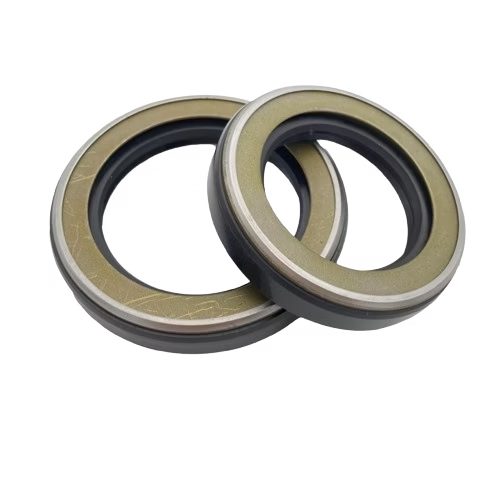
Agricultural oil seals are rotary shaft seals used in tractors, combine harvesters, seeders, planters, tillers, balers, irrigation equipment, pumps, engines, axles, gearboxes, hubs, and hydraulic systems.
Their main job is to retain oil or grease inside rotating components while preventing external contaminants from entering the machine.
In clean factory equipment, an oil seal may mainly deal with oil leakage. In agricultural machinery, the seal must fight a much harsher environment: mud, dust, sand, water, crop fibers, fertilizer, vibration, and often poor maintenance conditions.
Main Functions in Agricultural Machinery
Prevent Lubricant Leakage
Oil seals retain gear oil, grease, transmission fluid, or hydraulic oil inside components such as gearboxes, hubs, axle assemblies, and pumps. Once lubricant escapes, friction increases, temperature rises, and bearings or gears may fail earlier.
Block Dust, Mud, Water, and Crop Residue
Agricultural machines work close to soil, water, plants, and abrasive particles. A sealing lip without enough contamination protection can wear quickly.
This is where many buyers make mistakes. They install a standard single-lip oil seal in a muddy or dusty shaft position and then blame the rubber material when leakage appears. In many cases, the real problem is the wrong seal structure.
Protect Bearings and Shafts
A failed agricultural oil seal can allow mud, water, or sand to enter the bearing area. Once contaminants reach the bearing, grease breaks down, corrosion starts, and bearing noise or overheating follows.
Reduce Maintenance Cost and Downtime
A reliable agricultural oil seal helps reduce lubricant loss, bearing replacement, emergency repairs, and machine downtime. This is especially important during planting and harvesting seasons, when one day of downtime can cost more than the price difference between a standard seal and a higher-grade seal.
Where Are Agricultural Oil Seals Used?
Common Agricultural Machinery Applications
Tractors
Agricultural oil seals are used in tractor engines, wheel hubs, PTO shafts, axles, hydraulic pumps, transmissions, and differential systems.
Combine Harvesters
Harvesters use oil seals in drive shafts, gearboxes, cutter bars, hydraulic systems, bearing housings, and conveyor mechanisms. These positions often face dust, crop residue, high load, vibration, and long working hours.
Seeders and Planters
Seeders and planters use oil seals in rotating discs, metering systems, drive assemblies, and gearboxes. Dust and fertilizer exposure are common concerns.
Balers and Tillers
Balers and tillers use oil seals in rotary shafts, chain drives, gearbox shafts, and bearing protection areas. These machines often work in dusty or soil-contact environments.
Irrigation and Water Pump Equipment
Irrigation equipment uses seals in pump shafts, motor shafts, and rotating assemblies exposed to water, sediment, and sometimes agricultural chemicals.
Agricultural Oil Seal Application Selection Table
| Application Area | Main Contaminants | Common Seal Type | Recommended Material | Key Buyer Check |
|---|---|---|---|---|
| Tractor axle | Mud, water, dust | Double-lip oil seal | NBR / HNBR / FKM | Shaft wear, housing size, lip direction |
| Gearbox | Oil, heat, dust | Rotary shaft seal | NBR / FKM | Oil type, temperature, venting |
| Harvester drive shaft | Crop residue, dust | Dust-lip oil seal | NBR / HNBR | Speed, contamination level, runout |
| Irrigation pump | Water, sediment | Rubber-metal bonded seal | NBR / EPDM | Water compatibility, shaft corrosion |
| Hydraulic pump | Oil, pressure | High-performance oil seal | FKM / HNBR | Pressure, fluid type, temperature |
| Wheel hub | Mud, water, impact | Cassette seal / double-lip seal | HNBR / FKM / NBR | Mud exposure, shaft condition, installation space |
Here is the point many people miss: a tractor axle seal and a clean gearbox seal may have similar sizes, but they do not face the same working conditions. The wrong structure can fail even if the dimensions are correct.
How Agricultural Oil Seals Work
Basic Working Principle
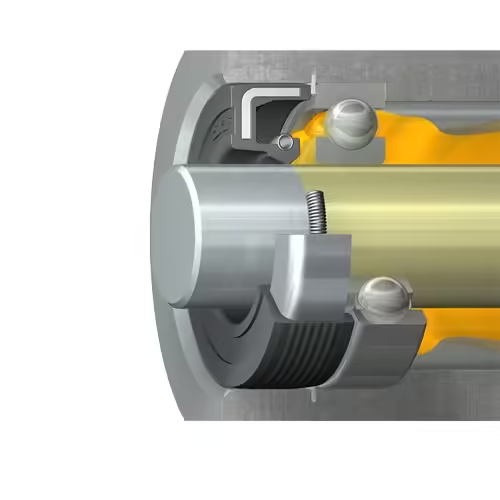
Agricultural oil seals work by creating controlled radial contact between the sealing lip and the rotating shaft.
The main sealing lip keeps lubricant inside the machine. The dust lip or auxiliary lip blocks external dirt, water, and crop residue. The garter spring helps maintain lip contact force during shaft rotation, temperature change, and normal rubber aging.
Key Structural Components
Rubber Sealing Lip
The main lip contacts the shaft and provides dynamic sealing. Its geometry, rubber hardness, compound, and finish affect leakage control, friction, and service life.
Dust Lip
The dust lip protects the main lip from mud, sand, dust, and crop debris. For agricultural machinery, this lip is often not optional. It is a practical protection feature.
Metal Case
The metal case supports the seal and helps maintain stable fitting inside the housing bore. Metal-cased seals need a properly machined housing.
Garter Spring
The spring maintains sealing lip tension. If spring force is too weak, leakage risk increases. If lip load is excessive, heat and wear may increase.
Why Agricultural Oil Seals Need Stronger Contamination Resistance
Farm machines rarely work in clean conditions. Soil, water, fertilizer, plant fibers, and abrasive dust attack the sealing lip continuously.
For exposed agricultural applications, stronger contamination resistance usually requires one or more of the following:
- Double-lip design
- Cassette seal structure
- Better rubber wear resistance
- Stable spring tension
- Proper shaft surface finish
- Correct installation depth
- Improved shaft protection
A cheaper seal can become more expensive if it fails early and damages the bearing.
Main Types of Agricultural Oil Seals
Single-Lip Oil Seals
Single-lip oil seals have one main sealing lip. They are mainly used to retain oil or grease in relatively clean environments.
When to Use Single-Lip Oil Seals
Single-lip seals can be used in protected gearboxes, enclosed housings, or low-contamination applications where the main requirement is lubricant retention.
When Not to Use Single-Lip Oil Seals
Do not use single-lip oil seals in exposed wheel hubs, tillage equipment, muddy fields, dusty harvesting conditions, or positions affected by washdown water unless the design has other external protection.
Double-Lip Oil Seals
Double-lip oil seals have a main sealing lip and a dust lip. They are more suitable for many agricultural machinery positions because they provide better protection against external contaminants.
From my experience, double-lip oil seals are often the safer baseline choice for tractors, harvesters, and exposed agricultural shafts.
Cassette Seals
Cassette seals are used in heavy-duty conditions where mud, water, shaft deflection, and contamination are serious. They are common in wheel hubs, axles, off-road equipment, and severe field applications.
Cassette seals cost more than basic rotary shaft seals, but the cost is often justified when downtime and bearing damage are expensive.
Rubber-Covered Oil Seals
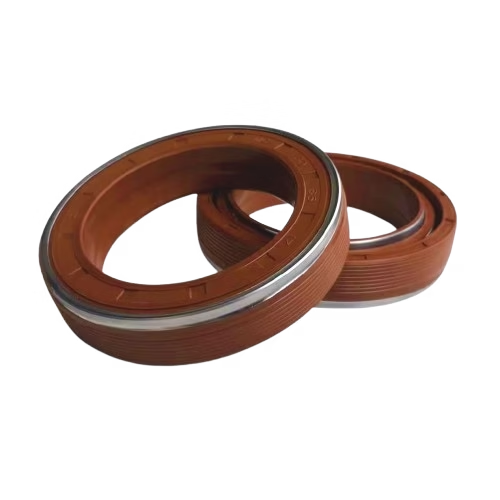
Rubber-covered oil seals provide better sealing between the outside diameter of the seal and the housing bore. They are useful when the bore surface is slightly rough, corroded, or less forgiving.
Metal-Cased Oil Seals
Metal-cased seals provide strong structural stability and accurate fitting in properly machined housings. They are less forgiving if the housing bore is damaged, corroded, or poorly finished.
Custom Agricultural Oil Seals
Custom agricultural oil seals are used when standard sizes, materials, or structures cannot meet the real application. OEM equipment, severe mud exposure, special fluid contact, unusual dimensions, or long service life requirements may all justify a custom seal.
Agricultural Oil Seal Structure Comparison
| Seal Type | Main Advantage | Limitation | Suitable Application | Buyer Decision Advice |
|---|---|---|---|---|
| Single-lip seal | Low cost, simple design | Weak contamination protection | Clean gearbox | Acceptable only when external dirt exposure is low |
| Double-lip seal | Better dust protection | Slightly higher friction | Tractor axle, harvester shaft | Better default choice for agricultural machinery |
| Cassette seal | Strong mud and water resistance | Higher cost | Heavy-duty hubs, axles | Use when failure cost is high |
| Rubber-covered seal | Better housing sealing | Requires careful installation | Rough or corroded housing | Good when bore sealing is a concern |
| Metal-cased seal | Strong dimensional stability | Less forgiving in rough bores | Precision housings | Use when housing quality is reliable |
| Custom seal | Application-specific design | Mold cost and lead time | OEM agricultural equipment | Best for special size, material, or performance needs |
Material Selection for Agricultural Oil Seals
NBR Agricultural Oil Seals
NBR is widely used for agricultural oil seals because it provides good oil resistance, wear resistance, and cost efficiency. It is suitable for many tractors, gearboxes, hubs, and general agricultural machinery applications.
Typical Temperature Range
NBR is commonly used around -30°C to +100°C, depending on compound formulation.
Suitable Media
NBR is commonly used with mineral oil, grease, diesel oil, and many standard lubricants.
Buyer Advice
NBR is a cost-effective choice for general agricultural machinery. However, it is not the best option for high-temperature engines, aggressive chemicals, or applications where heat aging is severe.
FKM Agricultural Oil Seals
FKM is used when higher heat resistance, oil resistance, fuel resistance, or chemical resistance is required.
Typical Temperature Range
FKM is commonly used around -20°C to +200°C, depending on the compound formulation.
Suitable Applications
FKM is suitable for high-temperature gearboxes, engines, fuel-contact areas, and chemically demanding environments.
Buyer Advice
Use FKM when the cost of failure is high or the working temperature exceeds the comfortable range of NBR. Do not choose FKM only because it “sounds premium.” Check the real temperature, fluid, and application first.
HNBR Agricultural Oil Seals
HNBR offers better heat, wear, ozone, and aging resistance than standard NBR. It is suitable for demanding agricultural and off-road applications.
Buyer Advice
HNBR is a practical upgrade for heavy-duty agricultural equipment, harvesters, muddy hubs, and applications requiring better durability than standard NBR.
EPDM Oil Seals
EPDM is not suitable for petroleum-based oils. It can be used in water, coolant, and some agricultural chemical environments.
Buyer Advice
Never use EPDM for mineral oil sealing unless the compound has been specifically evaluated for the medium. This is a basic mistake, but it still happens.
PU Sealing Elements
Polyurethane may be used where high wear resistance is needed, especially in hydraulic or abrasive environments. However, PU is not always suitable for standard rotary oil seal applications.
Rubber Material Comparison for Agricultural Oil Seals
| Material | Oil Resistance | Heat Resistance | Wear Resistance | Typical Use | Limitation | Selection Advice |
|---|---|---|---|---|---|---|
| NBR | Good | Medium | Good | General agricultural oil seals | Not ideal for high heat | Best cost-performance option for standard oil sealing |
| FKM | Excellent | Excellent | Good | Engines, high-temperature gearboxes | Higher cost | Use for heat, fuel, chemical, or high-value equipment |
| HNBR | Very good | Very good | Very good | Heavy-duty agricultural equipment | Higher cost than NBR | Good upgrade for severe field conditions |
| EPDM | Poor for oil | Good | Medium | Water or coolant systems | Not for mineral oil | Use only for compatible water-based media |
| PU | Depends on formulation | Medium | Excellent | Hydraulic and abrasive applications | Limited rotary use | Consider for special wear-resistant sealing elements |
Key Engineering Factors Before Ordering Agricultural Oil Seals
Shaft Diameter and Housing Bore Size
Buyers must confirm shaft diameter, housing bore diameter, and seal width. Guessing from an old seal is risky, especially if the old seal is worn, deformed, or not original.
Shaft Surface Roughness
The shaft surface should not be too rough or too smooth. Excessive roughness can wear the lip quickly. Poor surface finish can create leakage paths.
For rotary shaft seals, controlled shaft finish is important for stable sealing performance. A new seal installed on a damaged shaft will often leak again.
Shaft Hardness and Wear Condition
Shaft grooves, corrosion, rust, scratches, and eccentric rotation can cause early leakage even when the seal itself is correct.
This is not only a rubber issue. Many repeated leakage problems come from worn shafts, poor installation, or pressure build-up.
Shaft Speed
Higher shaft speed increases heat at the lip contact area. The manufacturer should check whether the material, lip design, and lubrication condition are suitable for the operating speed.
Operating Temperature
Agricultural equipment may face cold outdoor storage, hot engine areas, or high-load gearbox operation. Material choice must match real temperature conditions.
Lubricant Type
Confirm whether the seal contacts:
- Mineral oil
- Synthetic oil
- Grease
- Diesel
- Hydraulic oil
- Coolant
- Water
- Agricultural chemicals
Fluid compatibility directly affects swelling, hardening, cracking, and service life.
Pressure Conditions
Most standard oil seals are designed for low-pressure rotary sealing. If internal pressure is present, buyers must tell the manufacturer before ordering.
Blocked vents are a common cause of oil leakage. The seal may be blamed, but the real problem may be pressure forcing oil past the lip.
External Contamination Level
Mud, sand, dust, straw, fertilizer, washdown water, and pesticides can reduce seal life. For severe contamination, single-lip seals are usually a poor choice.
Installation Space and Housing Tolerance
Incorrect housing tolerance or insufficient installation space can deform the seal, reduce retention, or cause leakage. Always check the assembly drawing when available.
Common Agricultural Oil Seal Failure Causes
Lip Wear from Dust and Mud
Abrasive particles can damage the sealing lip and create leakage paths. In dusty or muddy environments, a dust lip or cassette structure is often necessary.
Incorrect Material Selection
Using NBR in a high-temperature or chemically aggressive environment may cause hardening, cracking, or swelling.
Shaft Grooves or Corrosion
A damaged shaft surface prevents stable lip contact. Replacing the seal without repairing the shaft often leads to repeated leakage.
Improper Installation
Tilted installation, hammer damage, sharp edges, dry start, or incorrect lip direction can damage the seal before the machine even starts working.
Excessive Shaft Runout or Misalignment
Agricultural machinery often operates under vibration and impact. Excessive runout can create uneven lip wear and leakage.
Pressure Build-Up
Blocked vents or internal pressure may push oil past the sealing lip.
Agricultural Oil Seal Failure Analysis Table
| Failure Symptom | Possible Cause | Recommended Check | Solution | Practical Meaning for Buyers |
|---|---|---|---|---|
| Oil leakage after short use | Shaft groove, wrong size, poor installation | Check shaft diameter and wear marks | Repair shaft or use suitable seal | Do not reorder the same seal blindly |
| Lip cracking | High temperature or wrong material | Check operating temperature | Use FKM or HNBR | Material upgrade may be cheaper than repeated failure |
| Mud entering bearing | Insufficient dust protection | Check seal structure | Use double-lip or cassette seal | Single-lip seals are risky in exposed areas |
| Seal pushed out | Pressure build-up or wrong housing fit | Check venting and bore tolerance | Improve fit or pressure control | Leakage may not be caused by rubber quality |
| Uneven lip wear | Shaft runout or misalignment | Measure shaft concentricity | Correct assembly condition | Mechanical condition affects seal life |
| Rubber swelling | Fluid incompatibility | Confirm lubricant or chemical type | Select compatible compound | Always provide media information before ordering |
Standard Agricultural Oil Seals vs Custom Agricultural Oil Seals
When Standard Oil Seals Are Suitable
Standard agricultural oil seals are suitable when the size, material, structure, and operating conditions match common industrial requirements.
They are often acceptable for:
- Common tractor gearbox sizes
- General oil-retention applications
- Low-contamination positions
- Distributor replacement markets
- Standard NBR or FKM rotary shaft seal requirements
When Custom Oil Seals Are Required
Custom agricultural oil seals should be considered when the equipment has:
- Non-standard dimensions
- Severe mud, water, or abrasive dust exposure
- Special oil, fuel, coolant, or chemical contact
- High temperature or heavy vibration
- OEM performance requirements
- Special lip design needs
- Unusual housing or shaft conditions
- Private label or special packaging requirements
OEM Customization Options
Custom Size
For non-standard shaft diameter, housing bore, or width.
Custom Rubber Material
For special heat, cold, oil, fuel, chemical, or wear resistance.
Custom Lip Design
For dust protection, pressure resistance, lower friction, or improved service life.
Custom Metal Case
For special housing fit, corrosion resistance, or structural reinforcement.
Custom Branding and Packaging
For distributors, aftermarket brands, and OEM supply programs.
Standard vs Custom Agricultural Oil Seal Decision Table
| Buyer Situation | Standard Seal | Custom Seal | Selection Advice |
|---|---|---|---|
| Common tractor gearbox size | Suitable | Usually not needed | Use standard seal if material and structure match |
| Severe mud and water exposure | May be insufficient | Recommended | Consider double-lip, cassette, or custom design |
| Old equipment with worn shaft | May leak quickly | Custom design may help | Check shaft repair before changing seal design |
| OEM mass production | Possible | Recommended | Custom design improves batch stability |
| Special oil or chemical contact | Risky without checking | Recommended | Confirm compound compatibility |
| Distributor replacement market | Suitable for common sizes | Useful for private label programs | Balance inventory cost and market demand |
How to Evaluate an Agricultural Oil Seal Manufacturer
Manufacturing Capability
A reliable agricultural oil seal manufacturer should have control over rubber mixing, mold design, vulcanization, trimming, bonding, inspection, and packaging.
A trading supplier may quote quickly, but a manufacturer with engineering support is more useful when leakage, wear, or custom requirements appear.
Material Formulation Experience
The manufacturer should understand NBR, FKM, HNBR, EPDM, silicone, polyurethane, and other sealing materials used in agricultural and industrial applications.
Material selection is not a catalog exercise. It depends on oil type, temperature, speed, contamination, and service expectations.
Mold Development Capability
For OEM and non-standard agricultural machinery, mold development capability is important. Custom molds allow the manufacturer to adjust dimensions, lip design, case structure, and rubber compound.
Dimensional Accuracy and Quality Control
Buyers should check whether the manufacturer controls:
- Inner diameter
- Outer diameter
- Seal width
- Lip geometry
- Spring tension
- Rubber hardness
- Rubber-metal bonding
- Appearance defects
- Packaging and batch consistency
Application Engineering Support
A professional supplier should ask about working conditions, not only quote by size.
If a supplier never asks about shaft speed, temperature, lubricant, contamination, or shaft condition, they may not understand the application risk.
Production Stability and Delivery Capacity
Agricultural machinery has seasonal demand. Stable delivery matters before planting and harvesting periods. For distributors and OEM buyers, late delivery can create serious supply problems.
Export and B2B Service Experience
International buyers should evaluate communication efficiency, export documentation, packaging quality, labeling, batch control, and long-term supply ability.
Cost vs Performance: How Buyers Should Make Decisions
Why the Cheapest Seal May Increase Total Cost
The cheapest seal can reduce unit purchase cost, but it may increase total cost through:
- Oil leakage
- Bearing damage
- Shaft wear
- Labor cost
- Emergency repair
- Machine downtime
- Warranty claims
- Customer complaints
This is not only a price issue. A seal is a small part, but it protects expensive rotating equipment.
When Premium Materials Are Worth the Cost
FKM or HNBR may be worth the higher cost when the application involves:
- High temperature
- High shaft speed
- Fuel or aggressive oil additives
- Heavy dust or mud
- Long operating hours
- Difficult maintenance access
- High downtime cost
Balancing Seal Life, Equipment Value, and Maintenance Difficulty
For low-speed, clean, non-critical equipment, a standard NBR oil seal may be enough. For harvesters, tractors, heavy-duty hubs, and critical gearboxes, a higher-grade seal can be more economical over the full service period.
Cost vs Performance Decision Table
| Application Condition | Low-Cost Seal Risk | Recommended Choice | Buyer Decision Advice |
|---|---|---|---|
| Clean, low-speed gearbox | Low | Standard NBR seal | Low-cost standard option may be acceptable |
| Muddy wheel hub | High | Double-lip or cassette seal | Do not use price-only selection |
| High-temperature engine area | High | FKM seal | Material upgrade reduces heat-aging risk |
| Heavy-duty harvester shaft | Medium to high | HNBR or custom seal | Consider service life and downtime |
| Seasonal emergency repair | High downtime risk | Higher-grade replacement seal | Availability and reliability matter more than small price savings |
Installation Notes for Agricultural Oil Seals
Check the Shaft Before Installation
Inspect the shaft for scratches, rust, grooves, eccentricity, and old seal wear marks. A damaged shaft can make any new seal fail.
Lubricate the Sealing Lip
Dry start can damage the sealing lip quickly. Apply compatible lubricant before installation.
Use Proper Installation Tools
Avoid direct hammer impact on the rubber lip or metal case. Use a flat, suitable installation tool to press the seal evenly.
Avoid Lip Inversion
Make sure the sealing lip faces the correct direction. The main lip usually faces the lubricant side, while the dust lip faces the contamination side.
Protect the Lip from Sharp Edges
Use a sleeve or guide when passing the seal over keyways, threads, splines, or shaft shoulders.
Confirm Installation Depth
Incorrect installation depth may position the lip directly on an existing shaft groove. Sometimes adjusting the installation depth can help the lip run on a better shaft surface, but this should be checked carefully.
Maintenance and Replacement Recommendations
Inspect During Seasonal Maintenance
Agricultural machinery should be checked before planting, harvesting, and heavy-duty field operation. Look for oil stains, dust accumulation, grease loss, or abnormal bearing noise.
Replace Seals When Bearings Are Replaced
Oil seals should usually be replaced together with bearings or shaft repairs. Reusing an old seal after bearing replacement is poor maintenance practice.
Monitor Early Leakage Signs
Small oil stains around the shaft area can indicate early seal damage. Dust sticking around the shaft may also show slight oil leakage.
Check Venting Systems
Blocked vents can increase internal pressure and cause leakage even when the seal is correct. This is one of the most overlooked causes of repeated oil seal failure.
Buyer Mistakes to Avoid When Purchasing Agricultural Oil Seals
Choosing Only by Size
Size matters, but material, structure, speed, temperature, contamination level, shaft condition, and pressure matter too.
Ignoring Shaft Wear
Replacing only the seal without repairing a worn shaft often leads to repeated leakage.
Using Standard Seals in Severe Mud Conditions
Heavy-duty agricultural environments often need dust lips, cassette seals, rubber-covered structures, or custom designs.
Not Confirming Fluid Compatibility
Different oils, greases, fuels, coolants, and chemicals require different rubber materials.
Ignoring Seasonal Delivery Needs
Agricultural equipment demand is time-sensitive. Buyers should plan seal orders before peak repair seasons.
What Information Should Buyers Provide to the Manufacturer?
Basic Seal Dimensions
Provide shaft diameter, housing bore diameter, seal width, and required quantity.
Application Information
Provide machinery type, installation position, shaft speed, temperature, pressure, and working environment.
Media Information
Confirm oil, grease, hydraulic fluid, fuel, water, coolant, or chemical exposure.
Existing Sample or Drawing
A drawing, photo, or physical sample helps the manufacturer confirm structure and dimensions.
Performance Requirement
Provide expected service life, contamination level, OEM requirement, packaging needs, and testing requirements.
Buyer Inquiry Checklist
| Information Needed | Example |
|---|---|
| Shaft diameter | 40 mm |
| Housing bore | 62 mm |
| Seal width | 10 mm |
| Material preference | NBR / FKM / HNBR |
| Application | Tractor axle |
| Medium | Gear oil |
| Temperature | -20°C to +100°C |
| Contamination | Mud, water, dust |
| Quantity | 5,000 pcs |
| Drawing or sample | Available / not available |
Manufacturer Note from DRO Rubber Seals
At DRO Rubber Seals, we help buyers review size, material, seal structure, shaft condition, working temperature, media compatibility, drawings, samples, and custom requirements before production. For OEM projects, distributor supply, or non-standard agricultural machinery seals, this review can help reduce selection errors before mold development or bulk ordering.
Practical Case Study: Agricultural Gearbox Oil Seal Leakage
Typical Application Scenario
Based on buyer feedback, one common problem occurs when a standard single-lip NBR oil seal is used in an agricultural gearbox exposed to dust, mud, and frequent washdown.
Reported Problem
The equipment shows oil leakage after short field operation, and dust accumulates around the shaft area.
Possible Causes
Insufficient Dust Protection
A single-lip structure may not prevent external particles from reaching the main sealing lip.
Shaft Surface Wear
The old seal may have created a groove on the shaft. If the new seal lip runs on the same worn track, leakage may continue.
Pressure Build-Up
A blocked gearbox vent may force oil past the sealing lip.
Incorrect Rubber Material
If temperature, oil additives, or chemical exposure exceed the capability of the rubber compound, the seal may harden, crack, or swell.
Recommended Checks
Before changing suppliers or blaming the rubber material, check:
- Shaft wear marks
- Housing bore condition
- Venting system
- Lubricant type
- Working temperature
- Contamination level
- Installation direction
- Seal lip structure
Possible Solution
A double-lip oil seal, improved shaft surface, correct installation depth, and compatible rubber material can help reduce leakage risk. For severe mud and water exposure, a cassette seal or custom agricultural oil seal may be more reliable.
When Should Buyers Choose an Agricultural Oil Seal Manufacturer Instead of a General Seal Supplier?
When the Application Is Exposed to Mud, Dust, and Water
Agricultural machinery needs sealing solutions designed for dirty and abrasive field conditions. A general seal supplier may only match the size, while a manufacturer can help evaluate the application.
When OEM Customization Is Needed
A manufacturer can develop molds, adjust rubber compounds, optimize lip design, and control production quality according to OEM requirements.
When Stable Batch Quality Is Important
For OEM production and distributor supply, consistent hardness, dimensions, bonding strength, appearance, and packaging are important.
When Technical Support Is Required
A professional manufacturer can help analyze leakage, material failure, shaft wear, pressure problems, installation damage, and replacement risks.
Relevant Standards for Agricultural Oil Seals
DIN 3760 and DIN 3761 for Rotary Shaft Seals
DIN 3760 and DIN 3761 are commonly referenced for rotary shaft seal dimensions and design types. They may be relevant when buyers need standard oil seal references.
ASTM D2000 for Rubber Material Classification
ASTM D2000 may be used to define rubber material properties for OEM or technical purchasing requirements.
ISO 3601 for O-Rings
ISO 3601 is more relevant when the agricultural sealing system includes O-rings. It is not the main standard for standard rotary shaft oil seals.
FDA or NSF Requirements
FDA or NSF requirements are usually not needed for agricultural machinery oil seals unless the seal is used in food-contact, drinking water, or special regulated equipment.
Do not add standards to a purchase requirement just to look professional. Use standards only when they are relevant to the product and application.
Final Buying Guide: How to Select the Right Agricultural Oil Seal
Step 1: Confirm Dimensions
Check shaft diameter, housing bore, width, and installation space. Do not rely only on a worn sample.
Step 2: Confirm Working Conditions
Identify shaft speed, temperature, pressure, lubricant, contamination, vibration, and washdown exposure.
Step 3: Choose the Right Material
Use NBR for general oil sealing, FKM for high heat or chemical exposure, HNBR for demanding wear and durability, and EPDM for compatible water-based media.
Step 4: Choose the Right Structure
Use single-lip seals for clean environments, double-lip seals for dusty applications, cassette seals for severe mud and water exposure, and custom seals for OEM or special applications.
Step 5: Evaluate Manufacturer Capability
Check material control, mold development, dimensional inspection, application support, production capacity, and export experience.
Step 6: Test Before Mass Purchase
For OEM or large-volume orders, sample testing is recommended before bulk production. A small test order can prevent a large purchasing mistake.
Practical Procurement Advice for Agricultural Oil Seal Buyers
Do not treat agricultural oil seals as simple rubber rings. They are small components working in dirty, rotating, abrasive, and often poorly controlled field conditions.
For clean and low-risk applications, a standard NBR agricultural oil seal may be enough. For muddy hubs, high-temperature gearboxes, hydraulic systems, harvesters, and OEM equipment, buyers should evaluate higher-grade materials, double-lip structures, cassette seals, or custom agricultural oil seals.
Before sending an inquiry, prepare the seal size, machinery type, application position, lubricant, temperature, speed, contamination level, quantity, and drawing or sample photos. This information allows the manufacturer to recommend a seal that fits the real working condition, not just the catalog size.
For agricultural oil seals, custom rubber seals, rotary shaft seals, O-rings, rubber gaskets, and industrial sealing solutions, contact DRO Rubber Seals for application review and quotation.
Website: drorubber.com
WhatsApp: +0086 15815831911
WeChat: +0086 13784044874