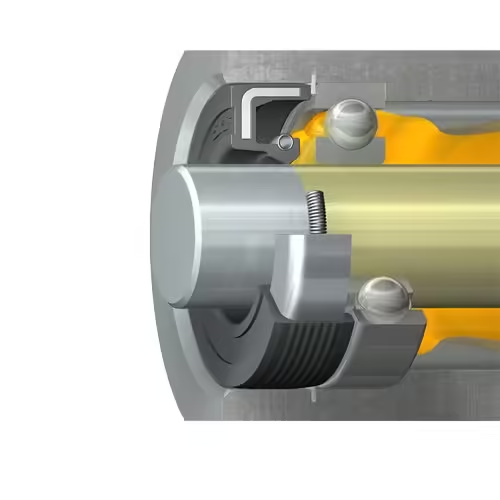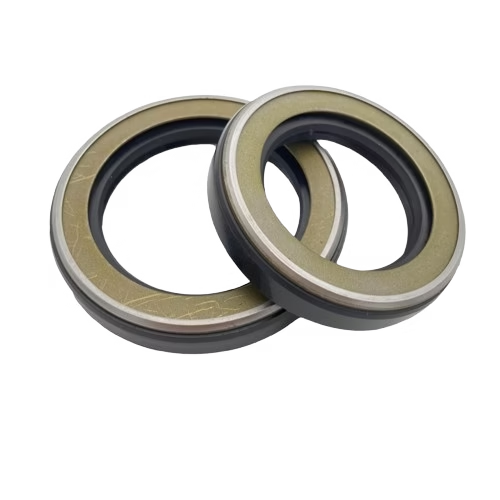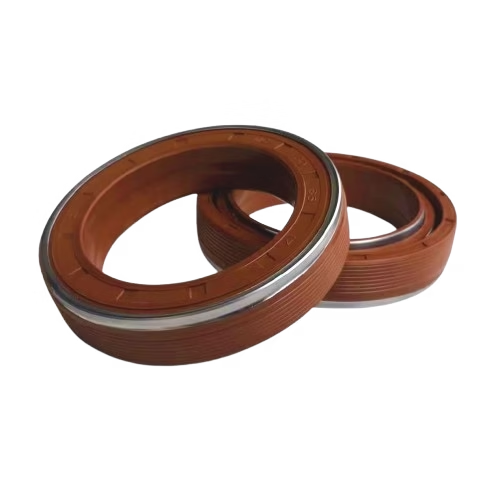
FFKM O-ring material grades are not interchangeable. Although all FFKM compounds belong to the perfluoroelastomer family, differences in base polymer chemistry, curing systems, fillers, crosslink density, post-curing, hardness, and purity controls can produce substantially different sealing performance.
One FFKM grade may provide broad resistance to aggressive chemicals, while another is optimized for high-temperature compression-set resistance, steam, amines, semiconductor plasma, high-purity processing, or high-pressure service.
For buyers and engineers, the correct question is not simply, “Do we need an FFKM O-ring?” The more important question is:
Which FFKM compound can maintain sealing force throughout the complete chemical, thermal, pressure, cleaning, and maintenance cycle of the equipment?
FFKM identifies the polymer family. It does not guarantee that every finished compound will provide the same chemical compatibility, temperature resistance, purity, mechanical properties, or service life.
Quick Answer
FFKM O-rings are available in multiple material grades because no single compound provides the best performance in every chemical, temperature, pressure, mechanical, and purity environment.
General-purpose FFKM grades cover a broad range of aggressive process chemicals. Specialized grades may be formulated for:
- High continuous temperatures
- Low compression set
- Amines and alkaline media
- Steam and hot water
- Semiconductor plasma
- Low particle generation
- Low extractables and outgassing
- Food or pharmaceutical contact
- High pressure and extrusion resistance
Before approving a grade, buyers should compare the actual compound data rather than relying only on the term “FFKM.” The review should include continuous and peak temperatures, chemical compatibility, compression set, hardness, pressure, extrusion clearance, purity, certification, process cycling, and expected maintenance cost.
Quick FFKM Grade Selection Overview
| FFKM grade category | Primary advantage | Typical applications | Main selection risk |
|---|---|---|---|
| General chemical-resistant grade | Broad chemical compatibility | Pumps, valves, mixers, and reactors | May not provide the best steam or extreme-temperature performance |
| High-temperature grade | Better heat aging and sealing-force retention | Furnaces, thermal processing, and hot oil systems | High dry-heat resistance does not confirm steam compatibility |
| Amine-resistant grade | Improved resistance to amines and alkaline media | Gas treatment, refining, and chemical plants | Performance changes with concentration, water content, and temperature |
| Steam-resistant grade | Better hydrothermal stability | Sterilization and process equipment | Dry-heat data alone can be misleading |
| Plasma-resistant grade | Reduced erosion and particle generation | Semiconductor process chambers | Must match the actual plasma chemistry and chamber position |
| High-purity grade | Controlled contamination, extractables, and outgassing | Semiconductor, pharmaceutical, and analytical equipment | Higher cost and stricter handling requirements |
| Food or sanitary grade | Compliance-focused formulation and documentation | Food, beverage, and pharmaceutical equipment | Compliance must apply to the exact compound and service conditions |
How to Choose an FFKM Grade by Buyer Scenario
Procurement teams often begin with a failure symptom, a cost concern, or an industry requirement rather than a complete compound specification. The following table provides a practical starting point.
| Buyer situation | Recommended direction |
|---|---|
| Need a lower-cost Kalrez alternative | Compare non-branded FFKM compounds using equivalent chemical, temperature, compression-set, hardness, and documentation requirements. Do not approve an alternative based only on price or the generic FFKM description. |
| Seal fails after high-temperature service | Check continuous temperature, peak duration, compression set, cleaning temperature, shutdown time, and actual gland squeeze. |
| Seal contacts amines or alkaline fluids | Use an amine-resistant FFKM grade and verify the exact amine, concentration, water content, temperature, and mixed-media exposure. |
| Seal is used in steam or SIP cycles | Do not rely on a dry-heat rating. Confirm hydrothermal resistance, steam-cycle temperature, pressure, duration, and number of cycles. |
| Semiconductor chamber seal is required | Check plasma resistance, particle generation, outgassing, extractables, metal-ion control, packaging cleanliness, and lot traceability. |
| Seal is used in a high-purity chemical system | Request low-extractable data, metal-ion controls, cleaning requirements, inspection records, and batch traceability. |
| Seal extrudes in a high-pressure valve or pump | Review hardness, gland clearance, pressure cycling, temperature, and the possible need for backup rings. |
| Existing FFKM O-ring fails without visible damage | Measure the groove and used seal, verify squeeze and tolerances, and investigate compression set, thermal cycling, and surface defects. |
This table should be used as an initial screening tool. Final approval still requires a review of the complete operating environment and gland design.
What Is an FFKM O-Ring Material Grade?
FFKM as a Polymer Family
FFKM is the ASTM designation for perfluoroelastomer rubber. It belongs to a group of highly fluorinated elastomers developed for demanding chemical and thermal sealing environments.
The polymer family gives FFKM its broad resistance characteristics, but an O-ring is not manufactured from base polymer alone. The finished compound may include:
- Base polymer
- Cure agents
- Reinforcing fillers
- Carbon black or non-black fillers
- Processing aids
- Pigments
- Stabilizing ingredients
- Application-specific additives
The material is then mixed, molded, cured, post-cured, inspected, cleaned, and packaged according to the manufacturer’s production process.
For this reason, two O-rings identified as FFKM can behave differently in steam, amines, plasma, high temperatures, or long-duration compression. The FFKM designation confirms the polymer category. It does not define the complete performance of the finished seal.
What Creates Differences Between FFKM Grades?
Several formulation and production variables influence the behavior of an FFKM O-ring.
Base polymer chemistry affects chemical resistance, low-temperature behavior, processability, and interaction with the cure system.
Cure chemistry controls how the polymer chains are crosslinked. It can influence thermal stability, compression set, chemical compatibility, and resistance to specific media.
Fillers and reinforcing agents affect hardness, modulus, tensile properties, extrusion resistance, contamination characteristics, and color.
Carbon black and non-black formulations may be selected for different mechanical or cleanliness requirements. A non-black material is not automatically cleaner or technically superior. Purity claims must be supported by compound-specific data.
Crosslink density affects stiffness, sealing-force retention, deformation, and chemical swelling. Excessive stiffness can also increase installation difficulty.
Post-curing conditions help stabilize the compound and remove certain process residues. Post-curing time, temperature, airflow, and cleanliness can be especially important for high-temperature and high-purity seals.
Purity controls may include controlled raw materials, dedicated handling, cleaning, inspection, special packaging, batch traceability, extractable testing, and metal-ion analysis.
These variables explain why selecting an O-ring by polymer name alone creates unnecessary technical and purchasing risk.
Grade Name Versus Compound Specification
Descriptions such as the following are not complete purchase specifications:
- FFKM O-ring
- Black FFKM
- High-temperature FFKM
- Chemical-resistant perfluoroelastomer
- Semiconductor-grade FFKM
- Food-grade FFKM
- Kalrez alternative
A meaningful purchase specification should identify measurable requirements, including:
- Exact approved compound or qualification criteria
- O-ring size and dimensional standard
- Hardness and tolerance
- Process chemicals and concentrations
- Continuous and peak temperatures
- Pressure and movement
- Required test methods
- Certification and traceability
- Cleanliness and packaging
- Application-specific validation requirements
A trade name can be useful when an exact compound is already approved. However, buyers evaluating an alternative should define the performance conditions that must be matched rather than requesting only a generic “equivalent.”
Main Categories of FFKM O-Ring Grades
General-Purpose Chemical-Resistant FFKM Grades
General chemical-resistant FFKM grades are designed for broad exposure to acids, solvents, hydrocarbons, and aggressive process fluids.
Typical applications include:
- Chemical-processing pumps
- Valve stems and bodies
- Reactors
- Mixers
- Sampling equipment
- Process instrumentation
- Mechanical seals
- Fluid-transfer systems
A general-purpose compound is often suitable when the chemical environment is well understood, operating temperatures remain within the grade’s validated range, and there are no unusual steam, amine, plasma, or purity requirements.
However, broad chemical resistance should not be interpreted as universal resistance. Mixed process streams, trace contaminants, cleaning chemicals, and high-temperature excursions can produce different results from exposure to one chemical at room temperature.
A chemical compatibility chart is therefore a useful screening tool, not a service-life guarantee.
High-Temperature FFKM Grades
High-temperature FFKM grades prioritize thermal stability, compression-set resistance, and sealing-force retention during long exposure.
The maximum published temperature should never be treated as a universal operating limit. Buyers should distinguish between:
- Continuous operating temperature
- Short intermittent peak temperature
- Heat-aging temperature in air
- Temperature while immersed in process fluid
- Maximum cleaning temperature
- Local surface temperature near the seal
- Temperature during startup or shutdown
Compression set becomes especially important at elevated temperature. A seal can remain visually intact while gradually losing its ability to maintain contact pressure against the gland surfaces.
Questions Buyers Should Ask About Temperature Ratings
Before approving a high-temperature grade, ask:
- Is the rating for continuous or intermittent service?
- How long can the intermittent peak be maintained?
- Was testing conducted in air or in a process fluid?
- What specimen or O-ring size was evaluated?
- What compression and exposure time were used?
- Was compression set measured after exposure?
- Does the rating include thermal cycling?
- Are steam or cleaning chemicals present?
- Does pressure increase during the temperature peak?
A grade with the highest published temperature is not automatically the best choice when steam, amines, aggressive chemicals, or thermal cycling are also present.
Amine-Resistant and Alkaline-Service FFKM Grades
Amines can be difficult for some elastomer formulations, especially when combined with high temperature, water, hydrocarbons, or changing concentrations.
Typical amine applications include:
- Natural-gas treatment
- Carbon dioxide and hydrogen sulfide removal
- Refining
- Coating and resin production
- Pharmaceutical processing
- Chemical synthesis
- Alkaline cleaning systems
Possible failure symptoms include:
- Swelling
- Softening
- Hardening
- Cracking
- Permanent deformation
- Loss of sealing force
The description “amine resistant” is still not sufficient by itself. Buyers should provide:
- Exact amine name
- Concentration
- Water content
- Operating temperature
- Pressure
- Other gases or hydrocarbons
- Cleaning chemicals
- Exposure and shutdown cycle
A grade that performs well in one amine mixture may not provide the same result in another concentration or at a higher temperature.
Steam- and Hot-Water-Resistant FFKM Grades
Dry heat and steam create different material stresses.
A compound that performs well in a hot-air oven may not provide equal resistance to:
- Saturated steam
- Superheated steam
- Pressurized hot water
- Water-treatment chemicals
- Repeated sterilization
- Condensation during cooling
- Rapid pressure and temperature changes
Steam exposure can affect the polymer network, cure system, fillers, and sealing-force retention. Repeated sterilization cycles may be more severe than one continuous exposure because the seal experiences expansion, contraction, pressure changes, and long periods under compression.
For pharmaceutical or sanitary equipment, the supplier should evaluate the complete clean-in-place and sterilize-in-place process, including:
- Cleaning chemical and concentration
- Rinse water
- Steam temperature
- Steam pressure
- Cycle duration
- Number of cycles
- Cooling method
- Shutdown time
A high-temperature rating in air does not confirm hydrothermal resistance.
Plasma-Resistant and Semiconductor FFKM Grades
Semiconductor seals may be exposed to oxygen, fluorine-containing gases, and other reactive plasma environments.
The main concerns can include:
- Surface erosion
- Particle generation
- Weight loss
- Cracking
- Outgassing
- Metal-ion contamination
- Process by-product deposition
- Loss of sealing force
- Chamber downtime
Selection depends on more than the plasma gas name. Chamber location, power level, temperature, pressure, direct or indirect plasma exposure, cleaning frequency, and seal geometry can all influence performance.
A compound used successfully in one chamber position may fail in another. A door seal, slit-valve seal, gas-delivery seal, and chamber-lid seal can experience substantially different operating conditions.
For semiconductor O-ring buyers, grade selection should not only consider plasma resistance, but also particle generation, extractables, metal-ion content, cleaning process, packaging, and lot traceability.
When comparing a semiconductor O-ring supplier, buyers should confirm that the supplier can discuss the exact process location and contamination requirements rather than recommending one universal “semiconductor-grade” FFKM compound.
High-Purity and Low-Contamination Grades
High-purity FFKM grades are used where contamination can affect product quality, analytical accuracy, manufacturing yield, or process qualification.
Relevant characteristics may include:
- Low extractables
- Controlled metal-ion content
- Low outgassing
- Low particle generation
- Non-black formulation
- Controlled filler system
- Special cleaning
- Cleanroom inspection
- Double packaging
- Lot traceability
Typical applications include semiconductor processing, high-purity chemical delivery, pharmaceutical manufacturing, laboratory instruments, analytical equipment, and vacuum systems.
Color alone does not prove purity. A white, cream, or translucent seal may still contain ingredients that are unsuitable for the process. Buyers should define the actual contamination limits and request the corresponding test method and documentation.
Food, Pharmaceutical, and Sanitary FFKM Grades
Food, pharmaceutical, and sanitary applications may require additional formulation and documentation controls.
Buyers should confirm:
- The exact compound covered by the compliance declaration
- Intended contact conditions
- Temperature and exposure duration
- Extraction or migration limitations
- Batch traceability
- Cleaning compatibility
- Sterilization compatibility
- Supporting supplier documentation
The statement “FDA compliant” should not be treated as a complete technical specification. Compliance must apply to the exact formulation and relevant conditions of use.
Material compliance also does not automatically approve the complete machine, assembly, or production process.
How FFKM Grades Differ in Real Operating Conditions
FFKM Grade Performance Comparison
| Performance factor | Why it matters | Questions to verify |
|---|---|---|
| Chemical resistance | Prevents swelling, dissolution, softening, or cracking | Which chemicals, concentrations, and mixtures are present? |
| Continuous temperature | Controls long-term aging and sealing durability | What is the normal temperature at the seal? |
| Peak temperature | Covers short thermal excursions | How hot, how long, and how frequently? |
| Compression set | Indicates the ability to retain sealing force | What squeeze, exposure time, and temperature apply? |
| Hardness | Influences installation, deformation, and extrusion resistance | What pressure and gland clearance are present? |
| Plasma resistance | Controls erosion and particle generation | Which gases, power levels, and chamber positions apply? |
| Purity | Reduces contamination risk | Are extractables, metal ions, or outgassing controlled? |
| Certification | Supports regulated or controlled applications | Is documentation required for the exact compound and batch? |
Chemical Compatibility Is Grade-Specific
Chemical compatibility depends on:
- Chemical identity
- Concentration
- Temperature
- Pressure
- Exposure duration
- Chemical mixtures
- Dissolved gases
- Cleaning agents
- Process by-products
- Shutdown conditions
A seal exposed to one solvent at 25°C may behave differently when the same solvent is used at 200°C under pressure. A small amount of water, acid, amine, or cleaning chemical can also change the exposure environment.
Compatibility charts should be used to eliminate clearly unsuitable materials. Final approval for critical service should be supported by compound-specific data, laboratory testing, field experience, or a controlled application trial.
Temperature Rating Does Not Tell the Full Story
Temperature can affect an FFKM O-ring in several ways:
- Accelerated chemical attack
- Hardening
- Softening
- Loss of tensile properties
- Increased compression set
- Thermal expansion
- Reduced extrusion resistance
- Higher friction
- Faster plasma erosion
A temperature value measured through hot-air aging cannot represent every chemical immersion, steam, vacuum, or pressure condition.
Buyers should focus on long-term sealing-force retention under the actual operating cycle rather than selecting by maximum temperature alone.
Hardness and Mechanical Properties
Softer FFKM compounds may provide:
- Better conformity to minor surface irregularities
- Lower installation force
- Easier sealing at low pressure
- Lower risk of damaging fragile hardware
Harder compounds may provide:
- Better resistance to deformation
- Improved extrusion control
- Greater stability in larger clearances
- Easier handling in some large-size applications
However, harder is not automatically better. A high-hardness O-ring may require greater installation force, conform less effectively to imperfect surfaces, and become damaged when forced through sharp hardware.
Hardness should be selected together with gland clearance, pressure, movement, surface condition, and the possible use of backup rings.
Compression Set and Long-Term Sealing Force
Compression set describes the permanent deformation remaining after rubber has been compressed for a defined time and temperature.
For a static O-ring, the seal must continue applying contact force after:
- Long production runs
- High-temperature exposure
- Shutdown periods
- Pressure changes
- Cleaning cycles
- Thermal expansion and contraction
A compound with poor compression-set resistance may become permanently flattened. Leakage may then begin during cooling, restart, vacuum operation, or low-pressure service.
Compression-set values should only be compared when the specimen, test method, temperature, time, and compression conditions are equivalent.
FFKM Grade Selection by Application
Application-Based FFKM Grade Selection
| Application environment | Preferred grade characteristics | Additional checks |
|---|---|---|
| Aggressive chemical-processing equipment | Broad chemical compatibility | Mixtures, temperature, pressure, and cleaning cycle |
| Hot oil or thermal-processing system | High thermal stability and low compression set | Peak duration, oxidation, and thermal cycling |
| Amine or alkaline process | Confirmed amine-resistant formulation | Concentration, water content, and temperature |
| Steam sterilization | Hydrothermal and steam resistance | Cycle count, pressure, and cooling conditions |
| Semiconductor plasma chamber | Plasma resistance and low particle generation | Plasma chemistry, seal location, and contamination limits |
| High-purity pharmaceutical process | Low extractables and documented compliance | Cleaning media, sterilization, and traceability |
| High-pressure valve or pump | Suitable hardness and extrusion resistance | Clearance gap, pressure cycling, and backup rings |
Chemical-Processing Pumps, Valves, and Reactors
For chemical-processing equipment, buyers should review:
- Every process chemical
- Normal and upset concentrations
- Continuous and cleaning temperatures
- Static or dynamic operation
- Pressure fluctuations
- Equipment shutdown conditions
- Flushing and neutralization chemicals
- Expected maintenance interval
A valve seal may contact the process medium during production but remain exposed to concentrated cleaning chemicals during shutdown. Both exposures must be included in the material review.
Semiconductor Manufacturing Equipment
Important selection factors include:
- Chamber process
- Plasma chemistry
- Seal location
- Particle sensitivity
- Outgassing limits
- Extractable limits
- Metal-ion limits
- Replacement frequency
- Cleaning process
- Packaging cleanliness
- Lot traceability
The compound with the lowest reported particle generation is not necessarily the longest-lasting material in every plasma environment. Selection should balance erosion resistance, sealing-force retention, contamination limits, and maintenance requirements.
Buyers should also define whether the seal will be installed in direct plasma exposure, a remote location, a vacuum door, a gas-delivery system, or another chamber position.
Oil and Gas, Refining, and Gas Treatment
Potential exposures include:
- Amines
- Sour-gas components
- Hydrocarbons
- Water
- Corrosion inhibitors
- High temperature
- Pressure cycling
- Rapid decompression
FFKM selection alone does not solve every high-pressure gas sealing problem. The compound, hardness, seal cross-section, gland clearance, pressure-release rate, and backup-ring arrangement must function as one system.
Where rapid gas decompression is possible, the seal may require application-specific validation and controlled decompression testing.
Pharmaceutical, Food, and Sanitary Equipment
Buyers should evaluate:
- Product-fluid compatibility
- Cleaning chemicals
- CIP temperature
- SIP temperature and pressure
- Steam-cycle frequency
- Extractable requirements
- Regulatory documentation
- Surface cleanliness
- Packaging
- Batch traceability
The cleaning or sterilization process can be more damaging than the product fluid itself. Selecting only according to the main process medium is a common cause of premature failure.
Aerospace and High-Temperature Industrial Equipment
Selection factors can include:
- Fuel compatibility
- Lubricating oil
- Hydraulic fluid
- Oxidation
- High- and low-temperature cycling
- Long service intervals
- Pressure variation
- Vibration
- Leakage consequences
For safety-critical equipment, qualification should include the actual fluid, temperature history, pressure cycle, hardware design, and inspection requirements.
Standard FFKM O-Ring Grades Versus Custom Compounds
Standard Grade vs. Custom FFKM Solution
| Selection factor | Standard FFKM grade | Custom or application-specific solution |
|---|---|---|
| Availability | Usually faster | May require development and production planning |
| Minimum order quantity | Often lower | Usually higher |
| Technical data | Based on existing compound data | Testing can be agreed for specific requirements |
| Chemical performance | Suitable for established media | Useful for unusual mixtures or process cycles |
| Hardness and dimensions | Limited to available options | Greater flexibility |
| Compliance | Existing declarations only | Special validation may be arranged |
| Qualification cost | Lower | Higher development and validation cost |
| Supply planning | Established production route | Requires longer-term planning |
When a Standard Grade Is Usually Sufficient
A standard grade may be appropriate when:
- Chemical exposure is well documented
- Temperature remains within an established range
- Standard O-ring dimensions are available
- Pressure is moderate
- Gland design is conventional
- There are no unusual purity requirements
- Existing compound documentation is sufficient
When a Specialized or Custom Grade May Be Required
A specialized solution may be justified for:
- Mixed chemicals with limited compatibility data
- Extreme thermal cycling
- Unusual hardness requirements
- High-purity or non-black formulations
- Plasma-specific exposure
- Special certification
- Non-standard dimensions
- High-pressure extrusion risk
- Rapid gas decompression
- Repeated failure of standard compounds
A fully new formulation is not always necessary. In many projects, the correct solution is an existing specialized FFKM grade combined with a custom O-ring size, improved groove design, backup ring, or controlled validation program.
Custom Size Versus Custom Material
These terms should not be confused.
Custom size means an existing FFKM compound is molded into a non-standard inside diameter or cross-section.
Custom material means the formulation, hardness, cure system, filler package, or production process is modified.
Application-specific sealing solution may combine a standard or specialized compound with a custom size, revised gland, backup ring, surface requirement, inspection plan, and validation procedure.
Why FFKM Grade Selection Cannot Be Based on Temperature Alone
The Common Oversimplification
Selecting the compound with the highest published temperature rating may still result in failure due to:
- Chemical incompatibility
- Steam exposure
- Amines
- Excessive extrusion gap
- Incorrect gland dimensions
- Installation damage
- Process contamination
- Incompatible cleaning agents
- Insufficient squeeze
- Excessive thermal expansion
A grade optimized for extreme dry heat may be less suitable for steam or a specific chemical mixture than another compound with a lower maximum temperature rating.
Combined Exposure Is More Important Than One Property
Real operating conditions often involve combinations such as:
- High temperature plus an aggressive solvent
- Steam plus pressure cycling
- Plasma plus contamination control
- Amines plus water and heat
- Chemical exposure followed by shutdown cooling
- Vacuum followed by high-pressure operation
- Cleaning chemicals followed by long storage
The correct grade is the one that survives the combined process cycle—not necessarily the compound with the highest value in one data-sheet column.
Common FFKM O-Ring Failure Modes and Likely Causes
FFKM Failure Analysis
| Observed condition | Possible causes | Recommended checks |
|---|---|---|
| Swelling | Chemical incompatibility or fluid absorption | Verify process, flushing, and cleaning fluids |
| Hardening | Heat aging or chemical degradation | Review actual temperature history |
| Softening | Solvent interaction or incorrect grade | Confirm concentration and exposure time |
| Cracking | Chemical attack, heat aging, or installation damage | Examine crack pattern and gland edges |
| Permanent flattening | High compression set or excessive temperature | Review squeeze, service time, and compound data |
| Extrusion or nibbling | High pressure or excessive clearance | Check gland gap, hardness, and backup rings |
| Surface erosion | Plasma or abrasive exposure | Review chemistry, power level, and seal location |
| Leakage without visible damage | Insufficient squeeze, tolerance issue, or surface defect | Measure the groove, O-ring, and mating surfaces |
Material-Related Failures
Material-related causes include:
- Incorrect FFKM grade
- Unverified chemical compatibility
- Excessive continuous temperature
- Poor compression-set resistance
- Unsuitable hardness
- Incorrect purity level
A material failure should not be concluded from appearance alone. Used seals should be compared with unused samples and reviewed together with actual process records.
Design- and Installation-Related Failures
Common causes include:
- Excessive stretch
- Twisting
- Rolling during assembly
- Sharp hardware edges
- Incorrect gland dimensions
- Excessive squeeze
- Insufficient squeeze
- Large extrusion clearance
- Rough or damaged sealing surfaces
- Incorrect installation lubricant
An expensive FFKM compound cannot compensate for a fundamentally incorrect gland design.
Process-Related Failures
Process changes are frequently overlooked. Examples include:
- A new cleaning chemical
- Higher cleaning concentration
- Unreported temperature spikes
- Faster pressure cycling
- Mixed-media exposure
- Product contamination
- Extended shutdown periods
- Changed sterilization procedures
When a previously successful O-ring begins failing, buyers should investigate process history before changing compounds.
Cost Versus Performance: Is the Highest-Grade FFKM Always Better?
Why FFKM Prices Vary
FFKM pricing can be influenced by:
- Base polymer chemistry
- Cure technology
- Specialized fillers
- Purity controls
- Post-curing
- Testing
- Certification
- Production volume
- Inspection
- Traceability
- Cleaning and packaging
- Mold size and tooling
A high-purity semiconductor seal and a general chemical-processing seal may require different production controls even when their dimensions are identical.
Evaluate Total Sealing Cost
The purchase price of the O-ring is only one part of the total cost.
A practical evaluation should include:
- Seal purchase price
- Replacement labor
- Equipment downtime
- Product loss
- Cleaning
- Requalification
- Hardware damage
- Safety risk
- Contamination risk
- Maintenance frequency
- Spare-parts inventory
A more expensive compound can be economical when it significantly reduces planned and unplanned maintenance. Conversely, purchasing the most specialized grade adds little value when a standard compound already meets the verified requirements.
Evaluating a Lower-Cost Branded FFKM Alternative
Buyers searching for a lower-cost Kalrez alternative or another branded FFKM replacement should compare the application requirements rather than relying on a general equivalence statement.
The comparison should include:
- Exact process chemicals
- Continuous and peak temperatures
- Compression-set data
- Hardness
- Pressure and extrusion conditions
- Steam or amine resistance
- Purity and extractable limits
- Required certifications
- Dimensional tolerances
- Batch traceability
- Validation test requirements
Two compounds can belong to the FFKM family without providing identical performance. A lower purchase price only creates value when the alternative is technically suitable and can be supplied with the required quality documentation.
When FFKM May Be Unnecessary
FFKM may not be required when:
- The chemicals are compatible with FKM, EPDM, HNBR, or another elastomer
- Temperatures are moderate
- Pressure is manageable
- Replacement is easy
- Leakage consequences are limited
- Purity requirements are low
- Existing field performance is satisfactory
FFKM should be selected because the application requires its performance—not because it is assumed to be universally superior.
What Buyers Should Provide Before Ordering FFKM O-Rings
Application Data Checklist
Provide the supplier with:
- O-ring size or groove dimensions
- Dimensional standard
- Static, reciprocating, rotary, or oscillating service
- Process fluid names
- Chemical concentrations
- Mixed-media information
- Cleaning and flushing chemicals
- Continuous temperature
- Minimum and maximum temperatures
- Peak temperature and duration
- Operating and peak pressure
- Pressure-cycle details
- Shaft or hardware movement
- Required hardness
- Color requirements
- Purity limits
- Required certificates
- Expected service interval
- Current failure symptoms
- Used-seal photographs where available
The quality of the compound recommendation depends directly on the quality of the application data.
Documentation Buyers Should Request
Depending on the equipment and industry, documentation may include:
- Material data sheet
- Chemical compatibility statement
- Certificate of conformance
- Lot or batch traceability
- Dimensional inspection report
- Regulatory declaration
- Physical-property report
- Cleanliness documentation
- Application-specific test report
Documentation should refer to the exact compound and, where necessary, the exact production batch.
Information That Should Appear on the Purchase Specification
A clear purchase specification should state:
- Exact material or approved compound
- Permitted alternative qualification procedure
- Hardness and tolerance
- O-ring dimensions
- Dimensional standard
- Color
- Quantity
- Inspection level
- Certification
- Packaging
- Cleanliness
- Traceability
- Application-specific testing
Avoid using only a trade name when multiple grades exist within the same material family.
Practical FFKM Grade Selection Process
Step 1: Define the Complete Exposure Environment
Document process chemicals, cleaning media, temperature, pressure, movement, cycling, shutdown, and contamination requirements.
Do not begin with a grade name. Begin with the application.
Step 2: Eliminate Chemically Unsuitable Grades
Use:
- Supplier compatibility data
- Previous field experience
- Fluid-immersion testing
- Process-fluid samples
- Failure history
Include cleaning chemicals and mixed-media exposure.
Step 3: Compare Thermal and Compression-Set Performance
Review long-term sealing-force retention rather than only maximum temperature.
Compare data under equivalent test conditions. A compression-set value measured at a lower temperature or shorter exposure should not be treated as directly superior.
Step 4: Confirm Mechanical Suitability
Review:
- Hardness
- Pressure
- Extrusion clearance
- Groove dimensions
- Surface finish
- Movement
- Installation method
- Backup-ring requirements
The compound and gland must be evaluated together.
Step 5: Confirm Purity, Certification, and Traceability
This step is particularly important for:
- Semiconductor equipment
- Pharmaceutical systems
- Food-contact applications
- Analytical instruments
- Safety-critical machinery
Confirm that documentation applies to the exact compound and production route.
Step 6: Validate the Selected Grade
Validation methods may include:
- Fluid immersion
- Heat aging
- Compression-set testing
- Pressure testing
- Leakage testing
- Process-cycle simulation
- Plasma-exposure testing
- Controlled field trials
Critical applications should not rely only on generic compatibility charts.
Typical Application Scenario: Replacing an FFKM Grade That Fails Prematurely
Reported Problem
Based on a typical buyer-feedback scenario, an FFKM O-ring installed in a chemical-processing valve develops permanent flattening and begins leaking after repeated high-temperature cleaning cycles.
The seal was originally selected because of its resistance to the primary process chemical.
Possible Causes
Possible causes include:
- The grade was selected mainly for chemical resistance
- Steam or hot-water resistance was not verified
- Compression-set resistance was insufficient
- Gland squeeze was excessive
- Cleaning temperature was higher than originally reported
- The seal remained compressed during long shutdown periods
- Thermal cycling reduced sealing-force retention
Recommended Checks
The buyer should:
- Confirm all process and cleaning media.
- Record continuous and peak temperatures at the seal.
- Review steam pressure and cycle duration.
- Measure the gland dimensions.
- Inspect and measure the used O-ring.
- Compare compression-set data under equivalent conditions.
- Evaluate a steam-resistant or thermally optimized FFKM compound.
- Conduct a controlled process-cycle trial.
Buyer Lesson
The original material was not necessarily poor quality. It may simply have been the wrong grade for the complete process cycle.
The correct selection must consider the primary chemical, cleaning media, steam, temperature, pressure, gland design, and shutdown duration together.
Buyer Mistakes to Avoid
Avoid:
- Treating all FFKM compounds as interchangeable
- Selecting only by maximum temperature
- Ignoring cleaning chemicals
- Specifying only a brand or polymer family
- Approving a grade without reviewing compression set
- Assuming higher hardness always prevents failure
- Ignoring gland clearance
- Ordering critical seals without batch traceability
- Replacing a failed seal without investigating the cause
- Treating compatibility charts as a substitute for testing
- Assuming a non-black compound is automatically high purity
- Using dry-heat data to approve steam service
- Approving a lower-cost alternative without defining measurable comparison requirements
Final FFKM Grade Selection Checklist
Before approving an FFKM O-ring material grade, confirm that:
- The exact chemical environment is documented
- Concentrations and mixtures are known
- Cleaning and flushing chemicals are included
- Continuous and peak temperatures are defined
- Peak duration and frequency are known
- Steam, amine, plasma, or purity requirements are identified
- Compression-set performance suits the service cycle
- Hardness is appropriate for pressure and gland clearance
- O-ring dimensions match the groove
- Extrusion risk has been reviewed
- Required certifications apply to the exact compound
- Traceability and inspection documents are agreed
- Packaging and cleanliness requirements are defined
- Validation testing has been completed for critical service
Frequently Asked Questions
Are all FFKM O-rings chemically resistant to the same fluids?
No. FFKM identifies a polymer family, while chemical resistance depends on the complete compound formulation, cure system, temperature, concentration, exposure time, and chemical mixture.
What is the difference between general-purpose and high-temperature FFKM grades?
General-purpose grades prioritize broad chemical compatibility. High-temperature grades usually prioritize heat aging, compression-set resistance, and sealing-force retention. A high-temperature grade may still have restrictions for steam, hot water, or specific chemicals.
Can a high-temperature FFKM grade resist steam?
Not necessarily. Dry-heat stability and hydrothermal resistance are different properties. Steam compatibility must be verified for the exact compound and sterilization cycle.
Which FFKM grade is suitable for amines?
Use a compound with documented resistance to the exact amine, concentration, water content, temperature, and mixed-media environment. The generic FFKM designation is not sufficient.
How should I select an FFKM grade for semiconductor plasma equipment?
Provide the plasma gases, power level, pressure, seal location, temperature, contamination limits, cleaning process, and expected replacement interval. Plasma performance should be evaluated for the actual chamber condition.
What hardness is best for an FFKM O-ring?
There is no universal best hardness. Softer compounds improve conformity, while harder compounds can improve extrusion resistance. Pressure, clearance, movement, groove dimensions, and installation conditions must be reviewed together.
Why did an FFKM O-ring fail when the compatibility chart showed good resistance?
Possible causes include higher actual temperature, chemical mixtures, cleaning agents, poor compression-set resistance, excessive gland clearance, installation damage, or an incomplete process description.
Are non-black FFKM grades better for high-purity applications?
Not automatically. Color does not prove low extractables, low metal content, or low outgassing. Request compound-specific purity data and test reports.
When should an FFKM compound be application-tested?
Testing is recommended when the service involves critical leakage consequences, unusual chemical mixtures, high temperature, steam, plasma, high pressure, contamination sensitivity, or limited field history.
Is FFKM always better than FKM?
No. FKM may be more economical when the fluid and temperature are compatible and the service conditions are moderate. FFKM is justified when the application requires its additional chemical, thermal, or purity performance.
Can a non-branded FFKM replace a Kalrez compound?
Possibly, but the replacement should not be approved only because both materials are classified as FFKM. Compare the exact chemical exposure, temperature, compression set, hardness, purity, pressure, documentation, and validation requirements.
What information does a supplier need to recommend an FFKM grade?
The supplier needs the O-ring size, gland dimensions, chemicals, concentrations, temperatures, pressure, movement, cleaning process, service cycle, hardness, certification, purity requirements, and existing failure symptoms.
Can FFKM O-rings be manufactured in custom sizes and hardness levels?
Yes, depending on tooling, compound availability, production quantity, and validation requirements. Buyers should distinguish between a custom size using an existing compound and the development of a modified material formulation.
Conclusion
Selecting the right FFKM O-ring material grade requires more than comparing maximum temperature ratings or general chemical-resistance claims.
The compound must match the complete application, including process chemicals, cleaning fluids, continuous and peak temperatures, pressure, movement, steam, plasma, purity, gland design, and maintenance cycle.
For many applications, an established standard grade is sufficient. Specialized or custom solutions become necessary when the service involves unusual chemical mixtures, extreme thermal cycling, high pressure, semiconductor contamination limits, repeated sterilization, or premature failure of standard compounds.
DRO Rubber Seals can review your application data, existing failure symptoms, dimensional requirements, and documentation needs to help identify a suitable standard or customized FFKM sealing solution.
Website: drorubber.com
WhatsApp: +0086 15815831911
WeChat: +0086 13784044874