Introduction: Understanding WD-40 and Its Properties
WD-40 is widely recognized as a versatile lubricant, penetrant, and cleaning agent. It’s commonly used in households, automotive repair shops, and various industrial settings for tasks ranging from loosening rusty bolts to preventing rust on metal tools. Given its broad range of applications, it’s natural to wonder if WD-40 is safe for use on rubber components, especially in critical applications such as seals, gaskets, or O-rings. This article explores the risks, potential effects, and alternatives for maintaining rubber parts.
Section 1: Composition of WD-40 and Its Impact on Rubber
Main Ingredients
WD-40 is primarily composed of petroleum-based oils, solvents, and propellants. While these ingredients are effective at reducing friction and cleaning surfaces, their chemical composition can affect various materials differently.
The Role of Solvents
The solvent content in WD-40 can temporarily soften and clean rubber surfaces. However, over time, these solvents can strip away essential oils from the rubber, causing it to become brittle and prone to cracking.
Material Sensitivity
Rubber materials vary in their sensitivity to petroleum-based substances. Natural rubber and silicone rubber are particularly vulnerable to damage from WD-40, while synthetic rubbers like nitrile and EPDM may withstand these substances better.
Section 2: Why WD-40 is Harmful to Silicone Rubber and Natural Rubber
Silicone Rubber
Silicone rubber is known for its heat resistance, water repellency, and chemical stability. However, it’s not resistant to petroleum-based oils. When exposed to WD-40, silicone rubber may swell, lose elasticity, and weaken structurally. Silicone is commonly used in seals, O-rings, and tubes, which are designed to resist oil contamination. Using WD-40 on these components could compromise their functionality.
Natural Rubber
Natural rubber offers excellent elasticity and flexibility but lacks resistance to petroleum-based solvents and oils. Exposure to WD-40 can cause natural rubber to swell, soften, and degrade over time. Since natural rubber is used in gaskets, tires, and hoses, it’s important to ensure compatibility with any maintenance product.
Section 3: Short-Term vs. Long-Term Effects of WD-40 on Rubber
Short-Term Use
Occasional, light application of WD-40 on rubber may not cause immediate damage. It can be useful for temporarily loosening stuck parts or cleaning surface contaminants.
Long-Term Use
Prolonged or frequent exposure to WD-40 can lead to more significant damage. Over time, WD-40 can extract oils from rubber, causing it to dry out, become brittle, and crack. For critical components like seals, gaskets, and weatherstripping, long-term exposure can lead to premature wear and failure.
Section 4: Types of Rubber That Tolerate WD-40 Better
EPDM Rubber
EPDM (ethylene propylene diene monomer) rubber is more resistant to oils, heat, and aging than silicone or natural rubber. While not entirely immune, EPDM typically handles limited WD-40 exposure better.
Nitrile Rubber (NBR)
Nitrile rubber is known for its oil resistance, making it a better choice for products like O-rings and seals exposed to WD-40. It is more compatible with WD-40 compared to silicone or natural rubber.
Other Synthetic Rubbers
Some synthetic rubbers, like neoprene, are less sensitive to petroleum-based solvents. However, it’s always advisable to verify compatibility before long-term exposure.
Section 5: When Should You Use WD-40 on Rubber?
Limited and cautious use of WD-40 on rubber may be acceptable in specific scenarios, such as:
- Loosening a stuck rubber component without using WD-40 as a long-term lubricant.
- Cleaning surface grime off weatherstripping or gaskets before applying a rubber-specific conditioner.
However, WD-40 should not be used as a regular lubricant or preservative for rubber parts, especially those exposed to heat, mechanical stress, or critical environments.
Section 6: Safer Alternatives to WD-40 for Rubber Care
Rubber-Specific Conditioners
For optimal care of rubber components, opt for silicone-based sprays, petroleum-free rubber protectants, or specialty lubricants formulated for rubber. These alternatives help maintain flexibility and prolong the lifespan of rubber materials.
Non-Damaging Cleaning Agents
To clean rubber surfaces without damaging them, use mild soap, water, or isopropyl alcohol. These products help maintain the rubber’s integrity and prevent long-term degradation.
Section 7: Practical Tips for Maintaining Rubber Components
- Regularly clean rubber parts with appropriate, non-harsh products.
- Apply UV protectants to shield rubber from sun damage and premature aging.
- Store rubber items in a cool, dry place to minimize environmental stress.
- Avoid using strong solvents or petroleum-based products unless specifically approved by the manufacturer.
Conclusion: The Verdict on Using WD-40 on Rubber
WD-40 can offer quick fixes, but it is not ideal for the long-term care of rubber materials like silicone or natural rubber. For optimal results, use products specifically designed to maintain rubber’s flexibility and durability. When in doubt, consult the manufacturer or a professional to ensure you’re using the right products and techniques for maintaining rubber components.
Call to Action
For high-quality rubber products, guidance, or specialized maintenance solutions, reach out to us:
Website: drorubber.com
WhatsApp: +0086 15815831911
WeChat: +0086 13784044874
How Safe Is It to Use WD-40 on Rubber?
A rubber seal does not usually fail the moment someone sprays WD-40 on it. That is exactly why this mistake keeps happening. The part looks fine today, the machine runs, and nobody connects next month’s swollen O-ring, sticky gasket, or leaking shaft seal with a quick spray used during installation.
From my experience, the real question is not “Will WD-40 instantly destroy rubber?” The better question is: Is WD-40 compatible with this rubber material, this sealing function, and this operating condition?
For many O-rings, rubber gaskets, oil seals, hoses, and industrial rubber seals, the safer answer is clear: do not use standard WD-40 as a long-term rubber seal lubricant.
Quick Answer: Is WD-40 Safe for Rubber?
WD-40 may be acceptable for brief, non-critical contact with some rubber parts, but it is not recommended for long-term use on rubber seals, O-rings, oil seals, gaskets, or hoses.
Standard WD-40 Multi-Use Product contains aliphatic hydrocarbons and petroleum base oil, according to the official WD-40 Safety Data Sheet (SDS), which is why compatibility with rubber materials must be checked carefully.
For critical sealing parts, use a lubricant matched to the rubber material and working condition, such as:
- silicone grease for many EPDM and general O-ring applications;
- clean system oil for many oil seal lips;
- PTFE-based assembly lubricant where suitable;
- food-grade lubricant where FDA or NSF requirements apply;
- manufacturer-approved seal assembly grease for OEM or industrial equipment.
Short Safety Verdict for Buyers
WD-40 is not generally recommended for long-term use on rubber. Short exposure may not immediately damage some rubber parts, but repeated or prolonged contact can cause swelling, softening, cracking, hardening, or reduced sealing reliability depending on the rubber material.
For O-rings, oil seals, and rubber gaskets, use a rubber-compatible lubricant selected according to:
- rubber material;
- temperature;
- fluid or medium;
- pressure;
- shaft speed;
- exposure time;
- sealing function.
A seal can fail even when the size is correct. The wrong lubricant can damage sealing performance just as easily as the wrong rubber material.
What Is WD-40 and Why Does It Matter for Rubber?
WD-40 Multi-Use Product is commonly used for water displacement, light lubrication, rust prevention, loosening stuck metal parts, and cleaning contaminated metal surfaces.
That matters because rubber compatibility is not decided by the word “lubricant” on a can. It is decided by chemical interaction, exposure time, temperature, compression, and the seal material.
A rubber seal lubricant must support:
- installation without tearing;
- stable compression after assembly;
- material compatibility;
- long-term elasticity;
- low friction for dynamic seals;
- no chemical conflict with oil, fuel, coolant, water, or process media.
Here is the point many people miss: a lubricant for metal parts is not automatically safe for rubber sealing parts.
A spray that works well on a hinge, rusty bolt, or metal surface may be a poor choice for an EPDM O-ring, an NBR oil seal, or a precision rubber gasket.
How WD-40 Can Affect Rubber Seals
Depending on the rubber compound and exposure condition, WD-40 or similar petroleum-based products may contribute to several sealing problems.
| Possible Effect | What It Means in Real Sealing Work | Buyer Risk |
|---|---|---|
| Swelling | Seal becomes larger than the original design size | Groove over-compression, poor fit, leakage |
| Softening | Rubber surface loses mechanical strength | Cutting, extrusion, poor sealing force |
| Hardening after aging | Seal loses flexibility | Cracking and poor compression recovery |
| Surface cracking | Visible degradation on sealing surface | Early leakage and replacement cost |
| Loss of elasticity | Rubber cannot return to shape | Reduced sealing pressure |
| Compression set | Seal stays permanently deformed | Static gasket leakage |
| Lip force change | Oil seal lip no longer contacts shaft correctly | Rotary shaft leakage |
| Surface contamination | Lubricant interferes with assembly or bonding | Poor gasket seating |
This is not only a maintenance issue. It is a material compatibility issue.
A cheaper spray can become more expensive if it causes one unplanned shutdown, repeated leakage, or early seal replacement.
Why Damage May Not Be Immediately Visible
Rubber degradation is often gradual. An O-ring may look acceptable after one spray but later lose dimensional stability under heat, pressure, and compression.
This is especially common when the seal is:
- compressed in a groove;
- exposed repeatedly;
- used near heat;
- installed in oil, fuel, coolant, or chemical media;
- used in dynamic sealing where friction and lip force matter.
That is why short-term success does not prove long-term compatibility.
Key Factors That Determine WD-40 Risk on Rubber
Rubber Material Type
Different elastomers react differently. NBR, EPDM, FKM, silicone, natural rubber, HNBR, and ACM do not share the same chemical resistance.
Treating all rubber as “just rubber” is one of the most common low-level mistakes in seal selection.
Contact Time
A quick wipe is lower risk than soaking. Repeated spraying is much worse than accidental overspray.
Temperature
Higher temperature accelerates chemical absorption and rubber aging. Compatibility at room temperature does not guarantee compatibility inside real machinery.
Compression and Sealing Load
A rubber part under compression is more sensitive to swelling and permanent deformation. This matters for O-rings, flange gaskets, pump seals, and static seals.
Application Medium
Oil, fuel, water, coolant, brake fluid, steam, grease, dust, mud, and chemicals all change compatibility requirements.
Rubber Compatibility with WD-40: Material Selection Table
| Rubber Material | Common Applications | WD-40 Risk Level | Main Concern | Better Alternative | Buyer Decision |
|---|---|---|---|---|---|
| NBR | Oil seals, O-rings, hydraulic seals | Medium | Swelling or reduced service life under repeated exposure | Clean system oil or compatible grease | Accept only brief accidental contact; not a primary lubricant |
| EPDM | Water, coolant, steam, some brake-fluid-related seals | High | Poor petroleum compatibility | Silicone grease or EPDM-approved lubricant | Avoid standard WD-40 |
| FKM / Viton | Fuel, oil, chemical-resistant seals | Low to medium | Not ideal as a long-term lubricant | FKM-compatible grease or PTFE lubricant | Confirm compatibility before use |
| Silicone | Food, medical, high/low-temperature seals | Medium | Possible swelling in oils | Silicone-compatible grease | Avoid unknown oil-based sprays |
| Natural Rubber | Elastic parts, vibration parts, simple seals | High | Softening, swelling, cracking, aging | Rubber-safe lubricant | Avoid petroleum-based sprays |
| HNBR | Automotive, oil, heat-resistant seals | Low to medium | Depends on formulation and exposure | Application-specific grease | Verify with working medium |
| ACM | Automotive oil seals | Medium | Oil and additive compatibility | Approved assembly lubricant | Do not assume compatibility |
NBR Rubber and WD-40
NBR rubber is commonly used in oil seals, hydraulic seals, and O-rings because it has good resistance to many mineral oils. Short contact with petroleum-based products may be less risky than with EPDM or natural rubber.
But that does not mean WD-40 is the correct long-term lubricant for NBR seals.
For oil seals and hydraulic sealing parts, use clean system oil or a compatible assembly grease instead. A temporary spray is not the same as a controlled seal lubricant.
EPDM Rubber and WD-40
EPDM is widely used in water systems, coolant systems, steam applications, and some brake-fluid-related sealing environments.
EPDM generally has poor compatibility with petroleum oils and hydrocarbon-based products.
My practical advice is simple: do not use standard WD-40 on EPDM rubber seals. Use silicone grease or an EPDM-approved lubricant when the application allows it.
This matters especially for:
- water pump O-rings;
- coolant hose seals;
- plumbing seals;
- steam sealing parts;
- outdoor rubber components.
Silicone Rubber and WD-40
Silicone rubber provides excellent flexibility over a wide temperature range, but it can swell in some oils and solvents.
WD-40 is not normally a good choice for long-term contact with silicone rubber sealing parts. For silicone seals, lubricant selection should be based on the application fluid, contamination sensitivity, and temperature range.
Do not assume silicone rubber is chemically universal just because it handles temperature well.
FKM / Viton Rubber and WD-40
FKM has strong resistance to oils, fuels, and many chemicals. It may tolerate WD-40 better than many other elastomers.
But better resistance does not automatically mean WD-40 is the best engineering choice.
For fuel systems, chemical equipment, and high-temperature sealing, use a lubricant confirmed for FKM and for the actual operating medium.
This is where many buyers make mistakes. They see “chemical resistant rubber” and assume the lubricant no longer matters. That assumption can still create leakage or contamination problems.
Natural Rubber and WD-40
Natural rubber is generally more vulnerable to petroleum-based oils and solvents.
WD-40 exposure may increase the risk of:
- softening;
- swelling;
- cracking;
- faster aging;
- loss of elasticity.
Natural rubber parts used for vibration, elastic support, or general sealing should be kept away from petroleum-based sprays unless compatibility is confirmed.
Can WD-40 Be Used on Rubber O-Rings?
Why O-Rings Are Sensitive to Lubricant Choice
O-rings depend on controlled compression, elasticity, and dimensional stability. Even small swelling can change the sealing force.
This is where many buyers make mistakes. They measure the O-ring size, find the same size, install it with whatever spray is available, and then blame the rubber supplier when leakage appears.
Size matching does not mean application matching. Lubrication matching is also part of application matching.
When Short-Term Contact May Be Acceptable
| Situation | Risk Level | Practical Advice |
|---|---|---|
| Cleaning nearby metal parts | Low to medium | Avoid direct soaking of the O-ring |
| Accidental overspray | Low if cleaned quickly | Wipe off immediately |
| Temporary moisture removal around non-critical parts | Medium | Do not repeat frequently |
| Non-sealing rubber-adjacent parts | Depends | Confirm rubber type first |
When WD-40 Should Not Be Used on O-Rings
Do not use WD-40 as an O-ring lubricant in:
- hydraulic systems;
- fuel systems;
- pneumatic sealing systems;
- water pumps using EPDM seals;
- food-grade or medical-grade sealing systems;
- high-temperature sealing positions;
- long-term static sealing applications;
- any application where leakage can cause safety risk or machine failure.
Recommended O-Ring Lubricants
| O-Ring Application | Better Lubricant Choice | Practical Meaning |
|---|---|---|
| EPDM water O-ring | Silicone grease | Reduces petroleum compatibility risk |
| NBR oil O-ring | System-compatible oil or grease | Matches operating fluid better |
| FKM fuel O-ring | Fuel-compatible assembly lubricant | Avoids contamination and swelling risk |
| Food-grade O-ring | FDA/NSF-approved lubricant where required | Supports compliance and safety |
| Low-friction assembly | PTFE-based lubricant if compatible | Helps prevent cutting during installation |
Can WD-40 Be Used on Rubber Oil Seals?
Why Oil Seal Lubrication Is Different
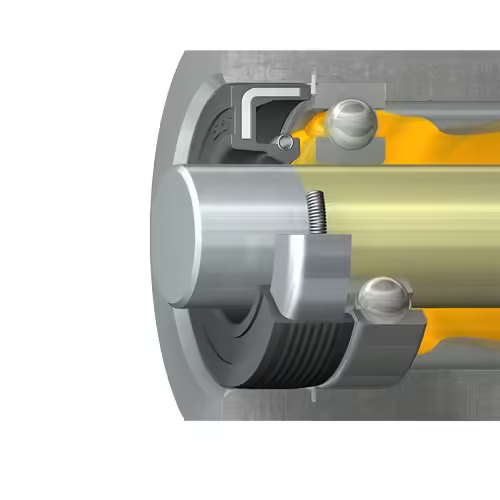
A rubber oil seal must maintain stable lip contact with a rotating shaft. The sealing lip, garter spring, shaft surface, oil film, and rubber material all work together.
For rotary shaft seals, lubrication is not only about making installation easier. It affects lip temperature, friction, shaft wear, and leakage risk.
Risks for Rotary Shaft Seals
| Risk | Why It Matters | Possible Result |
|---|---|---|
| Lip swelling | Lip geometry changes | Leakage or excessive friction |
| Loss of lip tension | Rubber and spring force become unstable | Poor shaft contact |
| Limited lubrication film | Solvent portion may evaporate | Dry running risk |
| Dust attraction | Contaminants gather near the sealing lip | Abrasive wear |
| Wrong material assumption | NBR, FKM, ACM, and PTFE behave differently | Early failure |
| Shaft wear ignored | New seal cannot fix damaged shaft | Repeat leakage |
Better Options for Oil Seal Installation
For most oil seal installation work:
- apply clean system oil to the sealing lip;
- use compatible assembly grease when specified;
- avoid dry installation;
- do not spray WD-40 as the main seal lubricant;
- check installation direction;
- inspect shaft wear and shaft roughness;
- confirm shaft diameter, housing bore, speed, pressure, and temperature.
A new seal will not compensate for a scratched shaft, poor housing tolerance, wrong lip direction, or contaminated lubricant.
Can WD-40 Be Used on Rubber Gaskets?
Static gaskets are usually less sensitive than dynamic oil seals, but they are still not immune to lubricant problems.
A gasket works by maintaining compression over time. If the rubber swells, softens, hardens, or takes excessive compression set, sealing pressure drops.
| Gasket Risk | Practical Meaning | Procurement Advice |
|---|---|---|
| Compression set increase | Gasket cannot recover after compression | Choose correct material and hardness |
| Swelling | Gasket size changes after exposure | Avoid incompatible oils and solvents |
| Surface contamination | Poor seating or bonding | Keep flange surfaces clean |
| Chemical incompatibility | Rubber degrades in service | Match material to fluid |
| Heat aging | Hardening and cracks | Check temperature range before buying |
Avoid WD-40 on:
- engine gaskets;
- EPDM water pump gaskets;
- fuel system gaskets;
- food-grade sealing gaskets;
- high-temperature flange gaskets;
- chemical processing seals;
- long-term compressed rubber gaskets.
WD-40 vs Silicone Spray vs Silicone Grease vs PTFE Lubricant
| Product Type | Main Use | Rubber Safety | Long-Term Seal Lubrication | Typical Applications | Buyer Decision |
|---|---|---|---|---|---|
| WD-40 Multi-Use Product | Water displacement, rust loosening, light cleaning | Variable | Poor to limited | Metal maintenance, temporary cleaning | Not preferred for rubber seals |
| Silicone Spray | Light rubber lubrication | Usually better | Limited | Door seals, light assembly | Useful for non-critical rubber movement |
| Silicone Grease | Seal assembly lubrication | Good for many rubbers | Good | O-rings, EPDM seals, plumbing seals | Often safer for rubber seals |
| PTFE Lubricant | Low-friction assembly | Depends on carrier | Good in selected uses | Industrial seal assembly | Check carrier compatibility |
| System Oil | Lubrication matching operating fluid | Usually suitable when specified | Good | Oil seals, hydraulic seals | Preferred when system fluid is compatible |
Do not confuse standard WD-40 Multi-Use Product with silicone-based lubricants. Product name, carrier fluid, and chemical composition matter.
Application-Based Safety Guide
Automotive Rubber Parts
For rubber door seals, silicone spray is usually preferred over standard WD-40. Door seals are not high-pressure sealing parts, but repeated petroleum exposure can still shorten rubber life.
For engine oil seals, use clean engine oil or the specified assembly lubricant. Do not use WD-40 as the main oil seal lubricant.
For coolant hoses and water system seals, avoid WD-40, especially where EPDM rubber is used.
Industrial Machinery
WD-40 should not replace oil seal lubricant, hydraulic seal assembly grease, bearing grease, or OEM-approved lubricants.
A machine that runs at speed, pressure, and heat is not a garage hinge.
Plumbing and Water Systems
EPDM is common in water sealing. Silicone grease is generally a safer choice than standard WD-40 for many plumbing O-rings and rubber seals.
Food-Grade or Medical Applications
Do not use standard WD-40 on rubber seals in food-grade or medical systems. Use FDA or NSF-compliant lubricants where required.
Failure Analysis: What Can Happen If WD-40 Damages Rubber?
Common symptoms include:
- seal becomes sticky or soft;
- O-ring becomes larger than original size;
- rubber surface cracks;
- gasket no longer fits correctly;
- oil leakage appears after installation;
- seal lip hardens or wears quickly;
- rubber part loses elasticity.
| Symptom | Possible Cause | Related WD-40 Risk | Recommended Check | Buyer Decision |
|---|---|---|---|---|
| O-ring swelling | Petroleum absorption | Material incompatibility | Confirm rubber type and lubricant used | Replace seal; do not reuse |
| Seal leakage | Loss of compression or lip force | Swelling or softening | Check seal size, groove, and shaft surface | Review material and lubricant together |
| Cracking | Rubber aging or solvent effect | Repeated exposure | Inspect hardness and surface condition | Upgrade material if needed |
| Sticky surface | Chemical softening | Solvent/oil interaction | Compare with unused seal | Replace immediately |
| Hard seal lip | Heat aging or lubricant failure | Reduced elasticity | Check temperature and lubrication | Review oil seal design |
| Gasket deformation | Compression set plus swelling | Long-term exposure under load | Check flange compression | Use compatible gasket material |
What to Do If WD-40 Was Accidentally Sprayed on Rubber
Step 1: Wipe Off Excess Product
Remove surface residue with a clean cloth. Do this immediately instead of letting the rubber soak.
Step 2: Identify the Rubber Material
Check drawings, supplier data, material markings, or previous purchase records.
Step 3: Inspect for Physical Changes
Look for:
- swelling;
- stickiness;
- cracking;
- hardness change;
- surface shine change;
- deformation;
- poor fit in groove.
Step 4: Clean According to Application Requirements
Use only a compatible cleaner. Do not “solve” one solvent mistake with a stronger solvent mistake.
Step 5: Replace Critical Seals
For pressure systems, rotating shafts, brake systems, fuel systems, chemical equipment, or safety-related machinery, replacement is safer than continued use.
Standard Rubber Seal vs Custom Rubber Seal: Why Compatibility Matters
A standard rubber seal is suitable when material, size, operating fluid, temperature, pressure, and installation condition are clearly within standard limits.
A custom rubber seal is necessary when the application involves:
- special chemical exposure;
- unusual temperature range;
- high shaft speed;
- non-standard groove or housing design;
- high dust, mud, water, or abrasive contamination;
- special hardness requirement;
- food-grade or regulatory requirement;
- repeated failure of standard seals.
| Requirement | Standard Seal | Custom Seal | Buyer Decision |
|---|---|---|---|
| Common oil sealing | Suitable | Optional | Choose standard NBR or FKM if conditions are normal |
| Unknown chemical exposure | Risky | Recommended | Do not guess material compatibility |
| Non-standard groove | Not ideal | Required | Size alone will not solve fit problems |
| High temperature | Depends on material | Recommended | Review FKM, silicone, PTFE, or other materials |
| Repeated seal failure | May not solve root cause | Recommended | Analyze shaft, groove, lubricant, and material |
| Special hardness or profile | Limited | Required | Custom tooling may reduce long-term failure cost |
| Food-grade requirement | Only if certified | Often required | Confirm regulatory and lubricant compatibility |
Buyer Mistakes to Avoid
Assuming All Rubber Materials Are the Same
EPDM, NBR, FKM, silicone, HNBR, ACM, and natural rubber have different chemical resistance. Treating them as the same material is a common reason for leakage.
Using WD-40 as an Assembly Lubricant for Seals
WD-40 may help loosen a rusty bolt, but that does not qualify it for O-ring grooves, oil seal lips, or compressed rubber gaskets.
Ignoring the Operating Fluid
The lubricant must not conflict with oil, fuel, water, coolant, brake fluid, grease, air, or process chemicals.
Not Checking Temperature and Pressure
Room-temperature compatibility is not enough. Real equipment adds heat, pressure, motion, compression, and contamination.
Reusing Swollen or Softened Rubber Seals
Once a seal has changed size, hardness, or surface condition, sealing reliability is already reduced. Reusing it is false economy.
What Information Should Buyers Provide to a Rubber Seal Supplier?
A good supplier cannot select the correct rubber seal from size alone.
DRO Rubber Seals helps buyers review size, material, structure, working conditions, drawings, samples, failure symptoms, and custom requirements before production. This reduces the risk of buying a seal that fits the dimension but fails in the application.
| Information Needed | Why It Matters |
|---|---|
| Seal type: O-ring, oil seal, gasket, shaft seal, custom seal | Determines structure and material choice |
| Rubber material if known | Prevents compatibility mistakes |
| Application medium | Oil, fuel, water, coolant, air, chemical, or grease changes material selection |
| Operating temperature range | Prevents hardening, swelling, and thermal aging |
| Pressure | Affects hardness, extrusion risk, and groove design |
| Shaft diameter and housing bore | Required for oil seal selection |
| Groove dimensions | Required for O-ring compression control |
| Shaft speed | Critical for rotary shaft seals |
| Dust, mud, water, outdoor exposure | Affects lip design and material choice |
| Required hardness | Affects compression and sealing force |
| Relevant standards | ISO 3601, DIN 3760, DIN 3761, ASTM D2000 where applicable |
| Food-grade requirement | FDA or NSF lubricant/material needs where required |
| Current failure symptoms | Helps identify root cause |
| Lubricants or chemicals used | Prevents repeating compatibility failures |
Recommended Alternatives to WD-40 for Rubber Seals
Silicone Grease
Silicone grease is commonly used for many rubber O-rings, especially EPDM seals in water and plumbing applications. It helps installation and reduces compatibility risk in many non-petroleum applications.
System-Compatible Oil
For oil seals, clean system oil is often the best choice for lubricating the sealing lip before installation.
PTFE-Based Assembly Lubricant
PTFE-based lubricants can reduce friction during assembly, but the carrier fluid must still be compatible with the rubber and application medium.
Food-Grade Lubricant
Food processing, beverage, and medical-related sealing systems require approved lubricants where regulations apply.
Manufacturer-Approved Seal Lubricant
For hydraulic systems, OEM equipment, high-speed shafts, chemical seals, and safety-related machinery, use the lubricant specified by the equipment or seal manufacturer.
Should You Use WD-40 on Rubber?
WD-40 should not be treated as a universal rubber-safe product. It may be acceptable for brief, non-critical contact, but it is not recommended for long-term use on rubber seals, O-rings, gaskets, hoses, or oil seals.
For industrial sealing applications, the safer approach is to identify:
- rubber material;
- operating fluid;
- temperature;
- pressure;
- shaft speed;
- groove or housing design;
- exposure time;
- lubricant compatibility.
For procurement teams, repair companies, distributors, and OEM engineers, lubricant compatibility should be part of seal selection.
Do not buy only by size.
Do not install with whatever spray is on the workbench.
Do not assume short-term success means long-term reliability.
Send the drawing, sample, material requirement, working medium, temperature, pressure, and current failure symptoms before ordering. That is how you reduce leakage risk, avoid repeated maintenance, and choose the right sealing solution instead of the cheapest part that fails early.
Website: drorubber.com
WhatsApp: +0086 15815831911
WeChat: +0086 13784044874