Quick Answer: How to Choose a Reliable Semiconductor O-Ring Supplier
A reliable semiconductor O-ring supplier should provide chemically compatible elastomer materials, low-contamination production control, stable dimensional accuracy, clean packaging options, custom size capability, and engineering support for vacuum, plasma, chemical, thermal, wet process, and gas delivery applications.
For semiconductor OEMs, maintenance teams, equipment builders, and distributors, the supplier should not only sell standard O-rings. A qualified supplier should help evaluate the sealing environment, recommend FKM, FFKM, EPDM, silicone, or custom compounds, support low-MOQ prototype orders, and provide repeatable production quality for long-term supply.
Buyers should confirm the actual application before ordering, including chemical exposure, temperature, pressure or vacuum condition, cleanliness requirement, groove design, sealing motion, batch quantity, packaging method, and required documentation.
| Buyer Requirement | What to Confirm With the Supplier |
|---|---|
| Chemical compatibility | Resistance to acids, solvents, gases, plasma, cleaning chemicals, or ultrapure water |
| Cleanliness | Low particle generation, washing options, clean handling, and controlled packaging |
| Material performance | FKM, FFKM, EPDM, silicone, or application-specific compounds |
| Dimensional control | ISO 3601 size reference, custom tolerance capability, and repeatable batch inspection |
| Application fit | Vacuum chamber, slit valve, gate valve, gas feedthrough, pump, valve, wet bench, or process module |
| Custom support | Low-MOQ prototypes, custom molds, non-standard sizes, hardness options, and sample validation |
| Supply reliability | Lead time, MOQ, batch consistency, labeling, documentation, and repeat order support |
What Are Semiconductor O-Rings?
Semiconductor O-rings are precision rubber sealing components used in wafer processing equipment, vacuum chambers, chemical delivery systems, gas delivery lines, pumps, valves, filters, wet process tools, and cleanroom-related machinery.
Their function is to prevent leakage, vacuum loss, process gas escape, chemical attack, particle contamination, and equipment instability. In general industrial machinery, an O-ring failure may cause oil leakage or mechanical downtime. In semiconductor manufacturing, the same failure can create contamination risk, wafer loss, unstable process results, or unplanned chamber maintenance.
This is why semiconductor O-rings should be selected by application conditions, not only by size and price.
How Semiconductor O-Rings Differ From General Industrial O-Rings
| Comparison Item | General Industrial O-Rings | Semiconductor O-Rings |
|---|---|---|
| Main priority | Basic sealing and cost control | Cleanliness, chemical resistance, reliability, process stability |
| Common materials | NBR, standard FKM, EPDM, silicone | High-performance FKM, FFKM, EPDM, silicone, specialty compounds |
| Contamination control | Usually limited | Important for critical process areas |
| Application risk | Leakage, wear, downtime | Contamination, vacuum loss, process failure, yield risk |
| Packaging | Standard bulk packaging | Clean, separated, double-bagged, or vacuum packaging may be required |
| Supplier role | Product seller | Technical sealing solution and production partner |
A semiconductor O-ring supplier should understand rubber behavior under compression, chemical exposure, vacuum, thermal cycling, plasma exposure, and long-term storage. The supplier should also understand procurement needs such as sample approval, small-batch development, repeat production, traceability, labeling, and export packaging.
Common Applications of Semiconductor O-Rings
Vacuum Chambers and Process Equipment
O-rings are used in chamber lids, access doors, vacuum flanges, viewports, inspection ports, transfer modules, and sealing interfaces. Important requirements include compression set resistance, low leakage, dimensional stability, and suitable outgassing performance.
For vacuum applications, a poor material choice may cause vacuum loss, unstable pump-down time, volatile residue, or contamination. The O-ring should be reviewed together with groove design, compression ratio, surface finish, installation method, and cleaning requirement.
Slit Valves, Gate Valves, and Transfer Modules
Slit valves and gate valves are common sealing locations in wafer transfer and vacuum module systems. Public technical descriptions of semiconductor slit valves describe their use between load lock chambers, transfer chambers, and process chambers, where low particle generation and service life are important concerns.
For these sealing points, buyers should carefully check:
- Whether the O-ring faces vacuum, process gas, plasma by-products, or cleaning chemicals
- Whether the seal is static or exposed to repeated valve movement
- Whether low particle generation is required
- Whether the replacement part must match an OEM drawing or existing groove
- Whether clean packaging or individual labeling is required
In fabs using equipment ecosystems from major tool platforms such as Applied Materials, Lam Research, or ASML, sealing discussions often involve high-value vacuum, gas, transfer, thermal, and process modules. This does not imply any supplier relationship. It simply reflects the type of equipment environment where buyers need precise seal data, correct materials, and careful replacement control. Applied Materials and Lam Research publicly describe etch and deposition-related semiconductor process technologies, while ASML describes EUV lithography systems used in advanced chip manufacturing.
Plasma Etching and Deposition Equipment
Plasma etching, deposition, and stripping processes can expose seals to aggressive gases, heat, plasma by-products, and particle-sensitive environments. In these areas, material selection is especially important.
FFKM or plasma-resistant specialty compounds may be considered when standard FKM cannot provide enough chemical resistance, thermal stability, or low-particle performance. The final choice depends on gas chemistry, exposure position, temperature, seal geometry, and acceptable maintenance interval.
Wet Process and Chemical Handling Systems
Wet process equipment may involve acids, alkalis, solvents, ultrapure water, oxidizers, and cleaning chemicals. In these environments, chemical compatibility should be evaluated by actual chemical type, concentration, temperature, exposure time, and cleaning cycle.
EPDM may work well in some water-based chemical or hot water applications. FKM may be suitable for certain gas, oil, or moderate chemical environments. FFKM may be required for aggressive chemical exposure or high-risk sealing points.
No rubber material should be presented as universally better. The correct material depends on the medium and failure consequence.
Gas Delivery Systems, Valves, and Fittings
Gas delivery systems require low leakage, stable compression, dimensional precision, and gas compatibility. O-rings used in valves, fittings, gas feedthroughs, and connectors may be small, but their failure can affect process control and equipment safety.
For gas sealing, buyers should confirm the gas type, pressure or vacuum condition, sealing surface, compression rate, hardness, and cleanliness requirement.
Pumps, Filters, and Auxiliary Equipment
Pumps, filters, cooling units, cleaning systems, and auxiliary equipment also use semiconductor-related O-rings. These areas may not directly contact wafers, but failure can still cause leakage, contamination, maintenance interruption, or unstable tool operation.
For lower-risk auxiliary sealing, standard FKM, EPDM, or silicone may be enough if compatible. For high-risk support systems, custom material selection may still be required.
Key Performance Requirements for Semiconductor O-Rings
Chemical Resistance
Semiconductor O-rings may contact acids, bases, solvents, oxidizing agents, process gases, cleaning chemicals, or ultrapure water. The supplier should verify material compatibility based on real operating conditions.
A material name alone is not enough. “FKM” or “EPDM” only describes the polymer family. Different compounds may perform differently in chemical resistance, compression set, cleanliness, and thermal stability.
Low Particle Generation
Particle contamination can affect equipment stability and wafer quality. Buyers should confirm whether the compound, molding process, flash trimming, surface inspection, cleaning, and packaging are suitable for clean applications.
A general industrial O-ring may seal at first, but it may not meet particle control expectations in sensitive semiconductor equipment.
Low Outgassing and Cleanliness
For vacuum and high-purity applications, buyers should evaluate volatile residue, post-curing, washing, packaging, and outgassing risk. Cleanliness requirements vary by sealing position. A pump seal and a chamber-facing seal may require different control levels.
ISO 14644-1 is commonly used for cleanroom air cleanliness classification by airborne particle concentration, and ISO Class 5 is often associated with the older Class 100 cleanroom concept in industry references.
Thermal Stability
Temperature resistance depends on material type, exposure time, compression, and chemical environment. A compound that works well in dry heat may fail quickly when the same temperature is combined with aggressive chemicals or plasma-related exposure.
Buyers should always evaluate temperature and chemistry together.
Compression Set Resistance
Compression set resistance is critical for long-term sealing. Poor compression recovery can cause leakage after thermal cycling, long compression time, chemical aging, or repeated maintenance cycles.
For chamber lids, flanges, static ports, and long-life sealing positions, compression set resistance is often more important than short-term elasticity.
Dimensional Accuracy
Semiconductor equipment often requires stable inner diameter, cross-section, flash control, and repeatable batch quality. ISO 3601-1 specifies inside diameters, cross-sections, tolerances, and designation codes for O-rings used in fluid power systems and is often used as a size and tolerance reference for standard O-ring communication.
For custom semiconductor O-rings, buyers may need tighter or project-specific tolerances depending on groove design and equipment risk.
Semiconductor O-Ring Material Selection Guide
Common Materials Used in Semiconductor Sealing
| Material | Typical Strengths | Limitations | Common Semiconductor Use |
|---|---|---|---|
| FKM | Good heat, gas, oil, and chemical resistance | Not suitable for all strong chemicals or plasma conditions | Pumps, valves, gas systems, moderate chemical exposure |
| FFKM | Excellent chemical and high-temperature resistance | High cost and longer lead time | Critical chambers, slit valves, gate valves, aggressive chemicals, plasma-related sealing |
| EPDM | Good resistance to hot water, steam, and some acids or alkalis | Poor resistance to oils and many hydrocarbons | Wet process, water-based chemicals, cleaning systems |
| Silicone / VMQ | Good flexibility and broad temperature performance | Lower tear strength and limited chemical resistance | Static sealing, clean environments, moderate-duty use |
| Specialty compounds | Designed for specific process risks | Requires validation | Custom semiconductor sealing applications |
When to Choose FKM Semiconductor O-Rings
FKM is often suitable when the application requires heat resistance, gas compatibility, and chemical resistance at a more economical cost than FFKM. It is commonly used in pumps, fittings, valves, gas systems, and less aggressive semiconductor equipment areas.
However, FKM should not be selected blindly. Buyers should check chemical type, gas exposure, temperature, hardness, compression set, and cleanliness requirements before approval.
When to Choose FFKM Semiconductor O-Rings
FFKM should be considered for aggressive chemical exposure, high-temperature process conditions, plasma-related environments, and critical sealing points where failure cost is much higher than seal cost.
Typical semiconductor-related locations may include critical vacuum valves, chamber seals, gas feedthroughs, slit valve seals, gate valve seals, and process module interfaces. For tools associated with etch, deposition, lithography, or wafer transfer systems, buyers should confirm whether the replacement O-ring must follow an OEM drawing, a maintenance part number, or a custom groove design.
FFKM is expensive, but it may reduce total cost when repeated seal failure causes downtime, contamination, chamber cleaning, or unstable process results.
When to Choose EPDM Semiconductor O-Rings
EPDM can be useful for water-based chemicals, hot water, steam-related cleaning systems, and some wet process environments. It should not be used for oil, fuel, or hydrocarbon-rich applications.
For ultrapure water or cleaning systems, buyers should also consider extractables, washing, packaging, and long-term swelling risk.
When Silicone O-Rings Are Suitable
Silicone may be suitable for clean static sealing applications with moderate chemical exposure. It offers good flexibility and temperature performance, but it is not ideal for high-wear, high-pressure, or aggressive chemical applications.
In semiconductor equipment, silicone should be used only when the environment matches its limitations.
Semiconductor O-Ring Material Comparison by Application Environment
| Application Environment | Recommended Material Direction | Main Risk if Wrong Material Is Used |
|---|---|---|
| Vacuum chamber | FKM, FFKM, low-outgassing specialty compounds | Vacuum loss, outgassing, contamination |
| Plasma process | FFKM or plasma-resistant specialty compound | Cracking, particle generation, rapid erosion |
| Slit valve / gate valve | FKM, FFKM, application-specific compound | Leakage, particle generation, short service life |
| Wet chemical process | EPDM, FKM, or FFKM depending on chemical type | Swelling, hardening, leakage |
| High-temperature process | FKM, FFKM, high-temperature specialty rubber | Compression set, thermal degradation |
| Gas delivery | FKM, FFKM, application-specific compounds | Leakage, chemical incompatibility |
| Ultrapure water | EPDM or suitable clean compound | Extractables, swelling, contamination |
This table should be used as a selection direction, not as final material approval. Final selection should be based on actual medium, concentration, temperature, pressure or vacuum, exposure time, sealing structure, and failure risk.
B2B Semiconductor O-Ring Supply Capability: What OEM Buyers Should Check
For semiconductor OEMs and equipment maintenance buyers, material knowledge is only one part of supplier evaluation. A practical semiconductor O-ring supplier should also support custom development, low-MOQ prototypes, clean packaging, repeat production, and clear communication.
Low-MOQ Prototyping for Custom Semiconductor O-Rings
Many OEM projects start with a small trial quantity before moving to batch production. Buyers may need 10, 20, 50, or 100 pieces for engineering validation, installation testing, or customer approval.
A supplier with low-MOQ prototype capability can help buyers reduce development risk before committing to large production.
Typical low-MOQ support may include:
- Existing mold size check
- Prototype mold development
- Small-batch compression molding
- Custom hardness trial
- Alternative material comparison
- Sample inspection report
- Clean packaging sample
- Repeat batch quotation after validation
Low MOQ is especially useful for imported equipment replacement, custom vacuum modules, special gas delivery systems, and semiconductor wet process tools where the buyer may not yet have final annual demand.
Custom Mold and Non-Standard Size Support
Standard O-rings are suitable for common grooves, but semiconductor equipment often involves special sealing interfaces, legacy equipment, imported replacement parts, and custom module designs.
A qualified supplier should support:
- Non-standard inner diameter
- Non-standard cross-section
- Metric and inch sizes
- Special tolerance requests
- Custom hardness
- Small trial production
- Batch production after sample approval
For critical projects, buyers should provide drawings instead of only measuring an old used O-ring, because used O-rings may be swollen, flattened, hardened, or stretched.
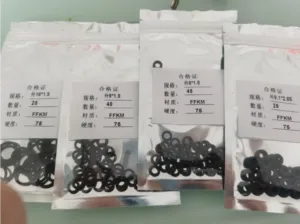
Cleanroom Cleaning and Double-Bagged Vacuum Packaging
For sensitive semiconductor applications, cleaning and packaging can be part of the technical requirement. When buyers request Class 100 / ISO 5 cleanroom handling, the supplier should clearly define the actual process instead of using vague words such as “clean packed.”
A practical clean packaging workflow may include:
- Pre-inspection before cleaning
Check dimensions, flash, surface defects, deformation, mixed material risk, and visible contamination. - Controlled cleaning or washing
Use a cleaning method suitable for the compound and buyer requirement. The process should avoid chemical residues that could affect the O-ring or application. - Drying in a controlled environment
Ensure the O-rings are dry before packing to reduce moisture and residue risk. - Final visual inspection
Inspect for dust, surface damage, parting line problems, or packaging contamination. - Inner clean bag packaging
Pack the O-rings in clean inner bags, often individually or in controlled quantities depending on buyer requirements. - Double-bagged packaging
Place the inner clean bag into a second outer bag to protect the parts during transfer, storage, and cleanroom entry. - Vacuum sealing or controlled sealing
Vacuum packaging may be used when required to reduce air exposure, protect cleanliness, and prevent bag movement during shipping. - Labeling and batch control
Labels may include material, size, hardness, quantity, batch number, production date, customer part number, and inspection status. - Export carton protection
Outer cartons should protect against deformation, dust, moisture, and mixed-batch risk during international shipment.
Not every semiconductor O-ring requires ISO 5/Class 100 handling. For auxiliary equipment, standard clean packaging may be enough. For chamber-facing or particle-sensitive applications, buyers should define the cleanliness level before production.
Repeat Production and Batch Consistency
OEM buyers care about more than the first sample. They need stable quality over repeat orders.
Supplier repeatability should include:
- Stable compound sourcing
- Controlled molding parameters
- Consistent post-curing conditions
- Dimensional inspection
- Appearance inspection
- Batch labeling
- Packing consistency
- Clear record keeping
For semiconductor equipment manufacturers and maintenance distributors, repeatable quality is often more valuable than one-time sample success.
How to Evaluate a Semiconductor O-Ring Supplier
Technical Material Knowledge
A qualified supplier should understand rubber behavior under chemical exposure, temperature, compression, vacuum, plasma, and long-term aging.
The supplier should explain why one material is suitable and why another may fail. This is important when buyers compare FKM, FFKM, EPDM, silicone, and specialty compounds.
Application Review Before Quotation
A strong supplier should ask about the real working conditions before recommending a material.
Important questions include:
- What chemical, gas, or fluid contacts the O-ring?
- What is the temperature range?
- Is the seal exposed to vacuum or pressure?
- Is the sealing condition static or dynamic?
- Is the O-ring used near plasma, process gas, or cleaning chemicals?
- What cleanliness or packaging level is required?
- Is the part for OEM production, maintenance, or replacement?
- Is there a drawing, sample, or OEM part number?
If a supplier gives a material recommendation without asking these questions, the risk of material mismatch is higher.
Cleanliness and Packaging Options
The supplier should support appropriate cleaning, inspection, and packaging based on application risk.
Possible options include:
| Packaging Requirement | Suitable Application |
|---|---|
| Standard bulk packaging | General auxiliary equipment |
| Separated small-bag packaging | Maintenance kits and distributor stock |
| Individual packaging | OEM assembly or controlled replacement |
| Double-bagged packaging | Cleanroom transfer and sensitive handling |
| Vacuum packaging | Clean, dust-controlled, or project-specific requirements |
| Custom labeling | OEM part number, batch control, and traceability |
Packaging should be confirmed before production, not after the goods are finished.
Dimensional Inspection and Quality Control
Important inspection items include inner diameter, cross-section, flash, parting line, surface defects, hardness, appearance, contamination, and batch consistency.
For OEM projects, buyers may request inspection reports, sample approval records, material data sheets, batch labels, or traceability information.
Stable Lead Time and Long-Term Supply
Semiconductor buyers often need both urgent replacement support and long-term repeat supply.
A reliable supplier should communicate clearly about:
- Sample lead time
- Mold lead time
- Batch production lead time
- MOQ
- Material availability
- Packaging cost
- Repeat order lead time
- Export shipping arrangement
For OEMs and distributors, stable supply planning reduces emergency purchasing and avoids inconsistent replacement parts.
What Information Buyers Should Provide Before Requesting a Quote
| Information Needed | Why It Matters |
|---|---|
| O-ring size or drawing | Determines mold, tolerance, and production feasibility |
| Material preference | Helps confirm FKM, FFKM, EPDM, silicone, or custom compound |
| Application equipment | Identifies sealing risk and working environment |
| Chemical exposure | Determines compatibility and swelling risk |
| Temperature range | Affects material life and compression set |
| Pressure or vacuum condition | Impacts sealing design and leakage risk |
| Static or dynamic sealing | Determines wear, friction, and compression requirements |
| Cleanliness requirement | Affects washing, inspection, and packaging |
| Quantity and annual demand | Helps evaluate MOQ, tooling, and production planning |
| Sample or prototype need | Helps arrange low-MOQ trial production |
| Required packaging | Confirms clean bag, double bag, vacuum pack, or labeling method |
| Required standards or documents | Supports OEM approval and procurement control |
The more accurate the application information, the more reliable the recommendation will be. Without this information, material selection becomes guesswork.
Standard Semiconductor O-Rings vs Custom Semiconductor O-Rings
When Standard O-Rings Are Suitable
Standard O-rings are suitable for common sealing grooves, maintenance replacement, general equipment sealing, and applications where existing dimensions meet standard size requirements.
They are often the best option when the working environment is not highly aggressive and the existing groove design already works well.
When Custom O-Rings Are Required
Custom O-rings may be required when the application involves non-standard groove dimensions, aggressive chemicals, unusual temperatures, vacuum requirements, special cleanliness needs, custom hardness, or equipment redesign.
| Selection Factor | Standard O-Ring | Custom O-Ring |
|---|---|---|
| Lead time | Usually shorter | Depends on mold and compound |
| Cost | Lower for common sizes | Higher for small batches or special materials |
| MOQ | Easier for stock sizes | Can be flexible for prototype projects |
| Design flexibility | Limited | High |
| Material options | Standard grades | Application-specific compounds |
| Packaging | Standard or clean packaging | Custom clean, double-bagged, or labeled packaging |
| Best for | Maintenance and common equipment | OEM design and critical process conditions |
Custom manufacturing is not only about size. It may also involve material formulation, hardness, surface quality, cleanliness, packaging, and documentation.
Important Engineering Factors Before Final Selection
Rubber Hardness
Common O-ring hardness may range around 60–90 Shore A depending on sealing pressure, groove design, installation method, and application environment.
A softer O-ring may seal with lower force but may extrude more easily under pressure. A harder O-ring may resist extrusion better but requires higher compression force and better groove control.
Groove Design and Compression
Improper compression can cause leakage, extrusion, excessive compression set, or premature failure. Groove dimensions should match the O-ring cross-section and application type.
For static sealing, the focus is stable compression and surface contact. For dynamic sealing, friction, lubrication, wear, and heat generation become more important.
Surface Finish and Contact Condition
Poor mating surfaces can cause leakage, abrasion, or particle generation. Semiconductor applications usually require careful control of sealing surfaces.
Scratches, dents, machining marks, contamination, and uneven compression can all reduce sealing reliability.
Temperature Plus Chemical Exposure
Material selection should never be based only on temperature range. A rubber compound that performs well at high temperature may still fail quickly when exposed to aggressive chemicals, oxidizers, solvents, or plasma-related environments.
Temperature and chemical exposure must be reviewed together.
Static vs Dynamic Sealing
Most semiconductor O-rings are used in static sealing, but pumps, valves, and moving parts may involve dynamic conditions. Dynamic applications require review of friction, lubrication, wear resistance, surface finish, and compression.
Using a static sealing material in a dynamic position can cause rapid wear and particle generation.
Common Failure Causes of Semiconductor O-Rings
| Failure Symptom | Possible Causes | Recommended Checks |
|---|---|---|
| Swelling | Chemical incompatibility | Review chemical type, concentration, temperature, exposure time |
| Hardening or cracking | Heat aging, plasma attack, chemical degradation | Check material grade and process conditions |
| Compression set | Excessive temperature, poor compound, over-compression | Review groove design and rubber material |
| Particle generation | Plasma erosion, poor surface quality, wrong compound | Check application environment and cleanliness requirement |
| Leakage | Wrong size, poor compression, surface defects, material shrinkage | Inspect dimensions, groove, mating surface, installation |
| Rapid wear | Dynamic movement, friction, poor lubrication | Review sealing motion and surface finish |
| Contamination | Extractables, residues, packaging issues | Confirm cleaning, post-curing, and packaging process |
Failure analysis should start with the actual operating environment, not only the damaged O-ring. The same symptom can have different causes.
For example, swelling usually points to chemical incompatibility, but the real cause may be higher chemical concentration, higher temperature, longer immersion time, or a cleaning chemical that was not included during material selection.
Buyer Mistakes to Avoid When Purchasing Semiconductor O-Rings
Choosing Only by Size and Price
In semiconductor applications, the cheapest O-ring may become expensive if it causes contamination, downtime, vacuum loss, or repeated maintenance.
Price matters, but it should be balanced with material suitability, process risk, and replacement cost.
Assuming All FKM or FFKM Materials Are the Same
Different compounds can perform very differently in chemical resistance, plasma resistance, cleanliness, compression set, and temperature stability.
Buyers should not approve a material only by polymer family. Compound design and production control also matter.
Ignoring Chemical Concentration and Temperature
Chemical compatibility must be reviewed together with concentration, temperature, and exposure time.
A material may resist a chemical at room temperature but fail faster at elevated temperature or under long exposure.
Using General Industrial O-Rings in Critical Equipment
General-purpose O-rings may not meet contamination, cleanliness, or process reliability expectations.
For critical process areas, buyers should confirm whether the material and manufacturing process are suitable for semiconductor-related use.
Not Confirming Packaging Requirements
For sensitive applications, packaging should protect against dust, deformation, contamination, material mix-up, and handling damage.
If clean packaging, double-bagging, vacuum packing, or custom labeling is required, it should be discussed before production.
Cost vs Performance: How to Make the Right Buying Decision
Why the Cheapest O-Ring May Not Reduce Total Cost
The cost of an O-ring is usually small compared with downtime, chamber cleaning, process interruption, wafer loss, emergency maintenance, and repeated replacement.
For low-risk auxiliary sealing, a cost-effective standard compound may be enough. For critical sealing points, higher material cost can be justified if it reduces failure risk.
When Premium Materials Are Worth the Cost
FFKM or specialty compounds may be worth the cost when the application involves aggressive chemicals, high temperature, plasma exposure, vacuum sensitivity, or high contamination risk.
The decision should be based on failure consequence. If seal failure stops production or affects process yield, premium material selection may be more economical in the long term.
How to Balance Cost, Lead Time, and Reliability
Buyers can classify sealing points by risk level:
| Application Risk Level | Recommended Buying Strategy |
|---|---|
| Low-risk auxiliary sealing | Use standard FKM, EPDM, or silicone if compatible |
| Medium-risk equipment sealing | Confirm material compatibility and dimensional quality |
| High-risk process sealing | Use validated high-performance or custom compound |
| Critical chamber, slit valve, or gate valve sealing | Consider FFKM or semiconductor-grade specialty solution |
This approach avoids over-engineering every seal while still protecting the most important equipment areas.
Typical Buyer Feedback-Based Scenario: Premature O-Ring Failure in Wet Process Equipment
Situation
Based on buyer feedback, a wet process equipment user experienced repeated O-ring swelling and leakage after switching to a lower-cost replacement seal.
Possible Causes
The likely risk factors included chemical incompatibility, insufficient review of concentration and temperature, and selection based only on size instead of application conditions.
The original O-ring may have been made from a compound suitable for the chemical environment, while the replacement O-ring only matched the dimensions.
Recommended Checks
The buyer should review:
- Chemical type and concentration
- Exposure temperature
- Cleaning cycle
- O-ring material and hardness
- Groove condition
- Compression rate
- Contact time
- Packaging and storage condition
Supplier Recommendation
For chemical-heavy semiconductor wet process applications, buyers should provide full operating conditions before ordering. The supplier can then compare EPDM, FKM, FFKM, or custom compounds instead of making a material decision based only on standard size.
Quality Control Requirements for Semiconductor O-Ring Suppliers
Incoming Raw Material Control
The supplier should maintain stable compound sourcing and material traceability where required. Material changes should be controlled, especially for OEM and repeat production projects.
Molding Process Control
Important process factors include molding temperature, pressure, curing time, mold condition, flash control, and operator consistency.
Poor molding control can cause dimensional variation, surface defects, weak parting lines, or unstable compression performance.
Post-Curing and Cleaning
Post-curing may improve material stability and reduce volatile residues depending on the compound and application.
For clean or vacuum-related applications, washing and controlled handling may also be required.
Dimensional and Appearance Inspection
Inspection should cover inner diameter, cross-section, surface defects, parting line, flash, contamination, deformation, and visible damage.
For tight-tolerance applications, buyers should confirm the inspection method and sampling plan before placing repeat orders.
Packaging and Labeling
Packaging should protect O-rings from dust, deformation, contamination, and material mix-up.
For OEM projects, labels may include size, material, hardness, batch number, quantity, production date, customer part number, and inspection status.
International Standards and Documentation to Consider
ISO 3601 for O-Ring Sizes and Tolerances
ISO 3601 is relevant when buyers need standard O-ring dimensions, size references, and tolerance guidance. It helps align communication between buyer and supplier when discussing inner diameter, cross-section, and dimensional tolerance.
ASTM D2000 for Rubber Material Classification
ASTM D2000 provides a classification system for vulcanized rubber materials and is often used to describe rubber material properties in procurement or engineering documents. ASTM notes that the system covers properties of vulcanized rubber materials and organizes designations by heat aging resistance, oil swelling resistance, and additional requirements.
It should not replace application testing, but it can help buyers and suppliers communicate material requirements more clearly.
ISO 14644 for Cleanroom Classification
ISO 14644-1 is relevant when buyers need to define cleanroom air cleanliness classification. For semiconductor O-ring cleaning or packaging, buyers should clearly state whether they require ISO Class 5/Class 100 handling, standard clean packaging, double-bagged packaging, or another controlled packaging method.
FDA, NSF, or Other Requirements
FDA, NSF, or similar requirements are only relevant when semiconductor equipment overlaps with water, clean utility, or regulated contact requirements. They should not be added automatically unless the application actually requires them.
Supplier Documentation Buyers May Request
Depending on the project, buyers may request:
- Material data sheet
- Inspection report
- Material compliance statement
- Batch information
- Traceability information
- Packing label details
- Sample approval record
- Clean packaging confirmation
- Low-MOQ prototype quotation
- Repeat production quotation
The required documentation should match the application risk and procurement process.
Checklist for Choosing a Semiconductor O-Ring Supplier
| Evaluation Item | Good Supplier Indicator |
|---|---|
| Material knowledge | Can explain why a material is suitable or unsuitable |
| Application review | Asks about temperature, chemicals, pressure, vacuum, equipment, and cleanliness |
| Custom capability | Supports non-standard sizes, hardness, compounds, and prototype molds |
| Low-MOQ support | Can support samples or trial batches before mass production |
| Quality control | Provides dimensional inspection and batch consistency |
| Clean packaging | Offers suitable clean, double-bagged, vacuum, or labeled packaging |
| Communication | Responds clearly with technical and commercial details |
| Lead time control | Can support samples, prototypes, and repeat production |
| Long-term supply | Suitable for OEM, maintenance, and distributor cooperation |
A reliable supplier should help reduce uncertainty before production. For semiconductor O-rings, the best supplier is not always the one with the lowest quotation, but the one that understands the sealing risk and can provide stable manufacturing support.
When You Should Choose a Custom Semiconductor O-Ring
A custom semiconductor O-ring is recommended when standard O-rings cannot meet the required chemical resistance, cleanliness, size, hardness, temperature range, compression behavior, packaging requirement, or equipment design condition.
Custom Size and Cross-Section
Custom sizing is useful for non-standard grooves, equipment redesign, imported equipment replacement, special sealing interfaces, or legacy equipment maintenance.
Custom Material Compound
Custom compounds may be needed for aggressive chemicals, plasma exposure, high temperature, low contamination, or unusual operating environments.
Custom Hardness
Custom hardness can help control sealing force, installation feel, extrusion resistance, and groove compatibility.
Custom Packaging
Custom packaging may be required for cleaner handling, project-specific labeling, individual packing, double-bagged packing, vacuum sealing, or controlled storage.
Why Work With a Professional Rubber Seal Manufacturer
A professional rubber seal manufacturer can support material selection, mold development, sample production, batch manufacturing, inspection, clean packaging discussion, and long-term supply.
For semiconductor-related applications, the supplier should not only sell O-rings. The supplier should help buyers reduce leakage risk, contamination risk, material mismatch, and procurement uncertainty.
DRO Rubber Seals supports standard and custom rubber sealing solutions for OEM buyers, maintenance teams, equipment manufacturers, distributors, and industrial sealing projects. For semiconductor O-rings, our recommendation process focuses on application data, material suitability, dimensional control, clean packaging needs, prototype feasibility, and practical manufacturing support.
Suitable Buyers
This type of sealing support is suitable for:
- Semiconductor equipment manufacturers
- OEM procurement teams
- Maintenance and repair companies
- Chemical handling system suppliers
- Vacuum equipment manufacturers
- Wet process equipment suppliers
- Industrial distributors
- Custom machinery manufacturers
Conclusion: Semiconductor O-Ring Procurement Should Be Application-Driven
Semiconductor O-rings should be selected based on chemical exposure, temperature, vacuum or pressure condition, cleanliness requirement, groove design, equipment position, packaging requirement, and failure risk.
A reliable semiconductor O-ring supplier should combine material knowledge, custom manufacturing capability, low-MOQ prototyping, clean packaging support, quality control, and long-term supply stability.
For critical semiconductor applications, buyers should avoid choosing O-rings only by size and price. The safer procurement approach is to share application details with the supplier and confirm the most suitable material, tolerance, cleanliness level, packaging method, and sample plan before placing an order.
Website: drorubber.com
WhatsApp: +0086 15815831911
WeChat: +0086 13784044874