Introduction
When buyers search for sealing products, two terms often appear together: oil seals and rubber seals. They may sound similar, and in some cases they are closely related. However, they are not exactly the same.
A rubber seal is a broad category of sealing product. It can include O-rings, gaskets, molded rubber parts, valve seals, pipe seals, and many other sealing components. An oil seal, on the other hand, is a more specialized sealing product, mainly designed to retain oil or grease around rotating shafts.
For purchasing managers, engineers, and maintenance teams, understanding the difference between an oil seal and a rubber seal is important. Choosing the wrong seal can cause leakage, equipment downtime, rubber failure, shaft wear, or unnecessary cost.
This guide explains the key differences between oil seals and rubber seals, including structure, materials, applications, cost, service life, and selection points for industrial equipment.

What Is a Rubber Seal?
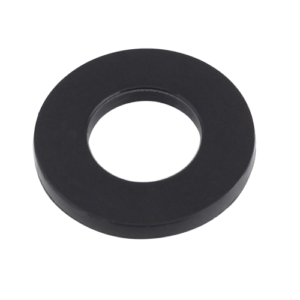
A rubber seal is a flexible sealing component made from rubber or elastomer materials. Its main purpose is to prevent leakage between two surfaces or block dust, water, oil, gas, or other media from entering or escaping a system.
Rubber seals are widely used in static and dynamic sealing applications. In industrial equipment, they are often used between flanges, covers, valves, pipes, housings, and mechanical joints.
Common rubber seal types include:
- O-rings
- Rubber gaskets
- Flat rubber washers
- Custom molded rubber seals
- Valve seals
- Pipe seals
- Flange seals
- Rubber-to-metal bonded seals
- Dust seals
- Hydraulic and pneumatic seals
In simple words, rubber seal is a large product category. It does not refer to only one specific seal design.
Common Materials Used for Rubber Seals
Different rubber materials are used for different working conditions. The right material depends on temperature, fluid type, pressure, chemical exposure, and expected service life.
| Material | Common Applications | Typical Temperature Range | Main Strength | Limitation |
|---|---|---|---|---|
| NBR | O-rings, oil seals, gaskets | -40°C to 120°C | Good resistance to oil and grease | Not ideal for ozone or long-term high heat |
| FKM | High-performance seals, oil seals | -20°C to 200°C / 250°C | Excellent heat, oil, fuel, and chemical resistance | Higher cost |
| EPDM | Water systems, pipe seals, weather seals | -50°C to 150°C | Good resistance to water, steam, ozone, and weather | Poor resistance to petroleum oil |
| Silicone / VMQ | Special temperature seals | -60°C to 200°C | Flexible in low and high temperatures | Moderate tear strength and oil resistance |
| PU | Hydraulic seals, wear-resistant seals | -30°C to 100°C | Strong wear resistance | Limited high-temperature resistance |
For buyers, material selection is often more important than the seal name itself. A well-designed seal can still fail quickly if the rubber material is not compatible with the working environment.
What Is an Oil Seal?
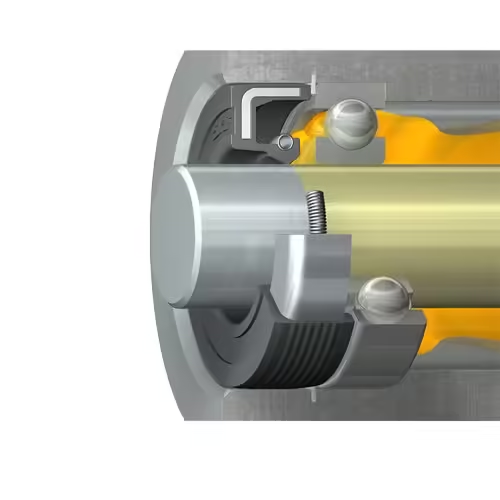
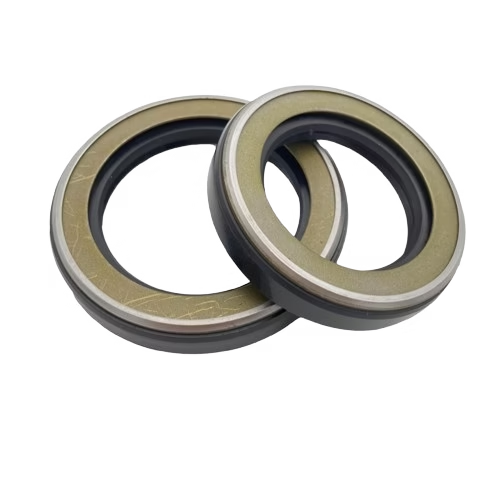
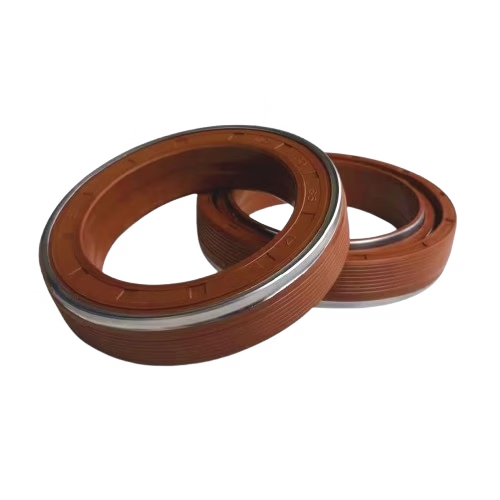
An oil seal, also known as a rotary shaft seal or lip seal, is a sealing component used to retain lubricants such as oil, grease, or hydraulic fluid inside equipment. It also prevents dust, dirt, water, and other contaminants from entering the system.
Oil seals are mainly used around rotating shafts. Typical applications include gearboxes, pumps, engines, motors, reducers, compressors, agricultural machinery, and industrial equipment.
A standard oil seal usually contains three main parts:
Sealing Lip
The sealing lip contacts the rotating shaft and prevents oil leakage. This is the most important working area of the oil seal.
Metal Case
The metal case gives the oil seal structural strength and helps it fit securely inside the housing bore.
Garter Spring
The spring provides constant pressure on the sealing lip, helping the lip maintain contact with the shaft during operation.
Because of this structure, an oil seal is more specialized than a simple rubber gasket or O-ring. It is designed for dynamic sealing, especially where a shaft is rotating and lubrication must be retained.
Oil Seal vs Rubber Seal: Quick Comparison Table
| Factor | Oil Seal | Rubber Seal | Buyer Decision |
|---|---|---|---|
| Product category | A specialized rotary shaft seal | A broad category of rubber sealing products | Oil seal is one type of sealing product; rubber seal is a wider term |
| Main function | Retains oil or grease and blocks contaminants around shafts | Prevents leakage in static or dynamic joints | Choose based on equipment structure |
| Typical application | Gearboxes, engines, pumps, motors, reducers | O-rings, gaskets, valves, pipes, flanges, covers | Oil seals are used for rotating shafts |
| Sealing condition | Mostly dynamic rotary sealing | Mostly static, but can also be dynamic | Static vs dynamic sealing is the first selection point |
| Structure | Lip, spring, metal case, rubber body | Can be simple rubber profile, O-ring, gasket, or molded part | Oil seals are more complex and specialized |
| Material | NBR, FKM, ACM, silicone, PTFE | NBR, EPDM, FKM, silicone, natural rubber, PU | Material depends on oil, water, chemical, and temperature |
| Cost | Higher than simple rubber gaskets or O-rings | Usually lower for simple shapes | Compare total cost, not just unit price |
| Failure risk | Lip wear, shaft leakage, spring failure, outer diameter leakage | Compression set, cracking, swelling, extrusion | Failure mode depends on application |
| Best for | Rotating shafts and lubricant retention | General sealing between parts | Match the seal type to the equipment |
Key Difference 1: Oil Seals Are More Specialized
The biggest difference is scope.
A rubber seal can mean many different products. It may be a simple O-ring, a flat gasket, a molded rubber part, or a rubber-to-metal bonded component.
An oil seal is more specific. It is designed for sealing around rotating or moving shafts where oil or grease must stay inside the machine.
This means an oil seal is not the opposite of a rubber seal. In many cases, an oil seal is actually a specialized rubber-based sealing product designed for rotary shaft applications.
That point is important for buyers. If a drawing says “rubber seal,” it may not be enough information. You still need to confirm the seal type, shape, material, dimensions, and application.
Key Difference 2: Static Sealing vs Dynamic Sealing
Most rubber seals are used for static sealing. For example, a rubber gasket between two flanges does not move during operation. Its job is to fill the gap and prevent leakage.
Oil seals are normally used for dynamic sealing. They work with rotating shafts, so the sealing lip must maintain contact while the shaft is moving.
This makes oil seal selection more sensitive to:
- Shaft diameter
- Shaft speed
- Shaft surface finish
- Lubricant type
- Working temperature
- Housing bore tolerance
- Installation method
- Pressure condition
If the application involves a rotating shaft and oil retention, a normal rubber gasket is usually not suitable. An oil seal is the correct choice.
Key Difference 3: Structure and Design
A simple rubber seal may only be a molded rubber ring or gasket. Its design can be very simple.
An oil seal usually has a more controlled structure. It often includes a sealing lip, metal case, and spring. Some oil seals also have a dust lip to prevent external contamination.
This structure allows the oil seal to handle shaft rotation and maintain sealing force over time.
For buyers, this means oil seals require more accurate specifications. It is not enough to provide only the outer size. You should confirm the full oil seal dimensions, lip design, material, and working conditions.
Key Difference 4: Cost and Performance
Rubber seals are usually more economical when the design is simple. For example, O-rings, flat gaskets, and rubber washers are generally low-cost sealing solutions.
Oil seals cost more than simple rubber seals because they require a more complex structure. The sealing lip, spring, metal case, and manufacturing accuracy all affect performance.
However, the lowest unit price is not always the best choice.
For a static pipe joint, a rubber gasket may be enough. But for a gearbox shaft, using the wrong seal can cause oil leakage, bearing damage, and downtime. In that case, an oil seal is the more cost-effective solution, even if the unit price is higher.
Buyers should compare total cost, including:
- Seal price
- Installation time
- Leakage risk
- Maintenance cost
- Machine downtime
- Replacement frequency
- Service life
A good seal is not always the cheapest one. It is the one that fits the working condition correctly.
Key Difference 5: Material Requirements
Both oil seals and rubber seals can be made from NBR, FKM, silicone, EPDM, PU, and other elastomers. But the material requirements are different.
For oil seals, oil resistance and wear resistance are usually important because the seal works with lubricants and shaft movement.
For rubber gaskets or static rubber seals, compression set, chemical compatibility, weather resistance, and sealing pressure may be more important.
For example:
- NBR is commonly used for oil seals because it has good oil and grease resistance.
- EPDM is common in water, steam, and weather sealing, but it is not suitable for petroleum oil.
- FKM is used when the application requires high temperature, fuel resistance, or chemical resistance.
- Silicone is useful for wide temperature ranges, but it may not be the first choice for heavy oil sealing or high-wear conditions.
This is why buyers should not choose rubber material only by price. The correct material can greatly improve service life.
Oil Seal vs Mechanical Seal: Are They the Same?
Oil seals and mechanical seals are also often confused, especially in pumps and rotating equipment.
They are not the same.
An oil seal is usually used for moderate-speed, moderate-pressure rotary shaft sealing. It is compact, cost-effective, and suitable for retaining oil or grease.
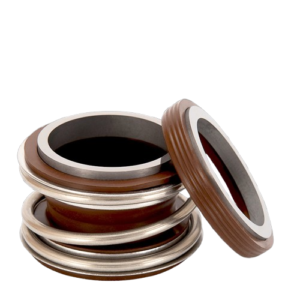
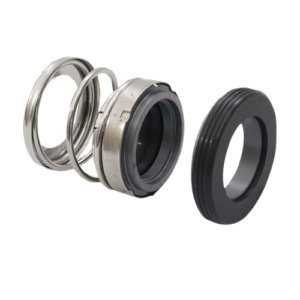
A mechanical seal is a more advanced sealing device used in pumps, compressors, mixers, and other rotating equipment. It uses precision sealing faces to control leakage, especially under higher pressure, higher speed, or more demanding fluid conditions.
| Factor | Oil Seal | Mechanical Seal |
|---|---|---|
| Main use | Retaining oil or grease around shafts | Sealing fluids in pumps and high-performance equipment |
| Structure | Lip seal with spring and metal case | Stationary ring, rotating ring, secondary seals |
| Cost | Lower | Higher |
| Pressure capability | Limited | Much higher |
| Installation | Relatively simple | More complex |
| Typical application | Gearboxes, motors, engines, reducers | Pumps, compressors, chemical equipment |
For normal gearbox or motor shaft sealing, an oil seal is usually enough. For high-pressure pumps, corrosive fluids, or demanding industrial systems, a mechanical seal may be required.
Real Application Examples
Example 1: Gearbox Shaft Sealing
A gearbox needs to retain lubricating oil around a rotating shaft. In this case, a normal rubber gasket cannot replace an oil seal.
The correct choice is usually a rotary shaft oil seal made from NBR, FKM, or another suitable material. The buyer should confirm shaft size, housing bore, shaft speed, oil type, and working temperature.
Example 2: Flange or Pipe Joint Sealing
A pipe flange or static cover needs to prevent leakage between two fixed surfaces. In this case, a rubber gasket or O-ring is usually more suitable.
There is no rotating shaft, so an oil seal is not necessary. The main selection points are material compatibility, compression, thickness, pressure, and temperature.
Example 3: Pump with High Pressure or Corrosive Fluid
A pump handles high-pressure or corrosive liquid. A simple oil seal may not provide enough sealing performance.
In this case, a mechanical seal may be needed. The buyer should confirm fluid type, pressure, speed, temperature, and whether the system requires a single seal, double seal, or cartridge seal.
Example 4: Custom Rubber Seal for Equipment Housing
Some equipment does not use standard O-rings or oil seals. The housing may require a custom molded rubber seal with a special shape.
In this situation, buyers should provide drawings, samples, 3D files, or application photos. The manufacturer can then recommend the correct rubber material and sealing structure.
Common Failure Risks When Choosing the Wrong Seal
Choosing the wrong seal can lead to leakage, short service life, and equipment damage.
1. Using a Rubber Gasket Instead of an Oil Seal
If a rotating shaft requires lubricant retention, a rubber gasket cannot perform the same function as an oil seal. It may cause immediate or early leakage.
2. Using the Wrong Rubber Material
If NBR is used in a high-temperature or chemical environment, it may harden, crack, or swell. If EPDM is used with petroleum oil, it may fail quickly.
3. Ignoring Shaft Surface Condition
For oil seals, the shaft surface is very important. A scratched, rusty, or rough shaft can damage the sealing lip and cause leakage.
4. Overdesigning a Simple Static Seal
Sometimes buyers choose a more complex seal than necessary. For a simple static flange, a good rubber gasket may be enough. Overdesign increases cost without improving value.
5. Ignoring Compression Set
For rubber seals used in static applications, compression set is a key failure factor. If the rubber loses elasticity, the seal may no longer maintain enough pressure.
6. Not Confirming Dimensions
Even a small error in inner diameter, outer diameter, thickness, or groove size can cause installation problems or leakage.
How to Choose the Right Seal for Your Application
Before ordering oil seals or rubber seals, buyers should confirm the following points:
| Selection Point | Why It Matters |
|---|---|
| Static or dynamic sealing | Determines whether you need a gasket, O-ring, oil seal, or mechanical seal |
| Shaft or no shaft | Rotating shafts usually require oil seals or mechanical seals |
| Medium | Oil, grease, water, fuel, air, chemical, or steam require different materials |
| Temperature | Prevents rubber hardening, cracking, or loss of elasticity |
| Pressure | High pressure may require special seal design |
| Speed | Important for rotary shaft oil seals |
| Material | Affects oil resistance, chemical resistance, and service life |
| Groove or housing size | Determines correct fit and sealing compression |
| Quantity | Affects production method, cost, and lead time |
| Drawing or sample | Helps avoid wrong production or wrong replacement |
For custom sealing projects, buyers should provide as much information as possible. A photo or sample can help, but technical data is better.
Which One Should Buyers Choose?
Choose a rubber seal if the application is a static joint, pipe connection, valve, flange, cover, or general sealing position.
Choose an oil seal if the application involves a rotating shaft and needs to retain oil, grease, or lubricant.
Choose a mechanical seal if the equipment operates under higher pressure, higher speed, corrosive fluids, or more demanding pump conditions.
The right seal is not chosen by name alone. It should be selected according to the actual working environment.
FAQ
Is an oil seal a rubber seal?
In many cases, yes. An oil seal often includes rubber material, but it is a specialized type of seal designed for rotary shaft and lubricant sealing applications.
What is the main difference between an oil seal and a rubber seal?
A rubber seal is a broad category that includes many sealing products. An oil seal is a specific type of seal mainly used to retain oil or grease around rotating shafts.
Can a rubber gasket replace an oil seal?
Usually not. A rubber gasket is mainly used for static sealing, while an oil seal is designed for dynamic shaft sealing.
Which material is best for oil seals?
NBR is commonly used for general oil seals. FKM is better for high temperature, fuel, and chemical resistance. The best material depends on the working environment.
Which material is best for rubber seals?
It depends on the medium. NBR is good for oil, EPDM is good for water and weather, FKM is good for high temperature and chemicals, and silicone is good for wide temperature ranges.
When should I use a mechanical seal instead of an oil seal?
A mechanical seal is usually better when the application involves high pressure, high speed, corrosive fluids, or demanding pump conditions.
Conclusion
Oil seals and rubber seals are closely related, but they are not the same thing.
A rubber seal is a broad sealing category used in many static and dynamic applications. An oil seal is a specialized seal designed mainly for rotating shafts, lubricant retention, and contamination prevention.
For buyers, the best choice depends on the actual application. A gearbox shaft may require an oil seal. A flange may only need a rubber gasket. A high-pressure pump may require a mechanical seal.
Before purchasing, always confirm the sealing condition, material, dimensions, temperature, pressure, medium, and equipment structure. This helps reduce leakage risk, extend service life, and lower long-term maintenance cost.
DRO Rubber Seals provides oil seals, O-rings, rubber gaskets, custom rubber seals, bonded seals, and other sealing solutions for industrial and automotive applications. We can support standard sizes, custom drawings, material recommendations, and sealing solutions based on your working conditions.
Website: drorubber.com
Email: [email protected]
WhatsApp: +0086 15815831911
WeChat: +0086 13784044874