Oil seals are small parts, but choosing the wrong one can quickly lead to oil leakage, contamination, shaft wear, and costly downtime. In many cases, the problem is not poor seal quality, but incorrect measurement or incorrect identification before ordering.
For maintenance teams, equipment manufacturers, distributors, and industrial buyers, measuring an oil seal is not only about reading three dimensions. A correct replacement also depends on shaft size, housing bore, seal type, material, working temperature, lubricant compatibility, and application conditions.
This guide explains how to measure and identify oil seals correctly, how to avoid common sizing mistakes, and what buyers should confirm before placing an order.
What Does an Oil Seal Do?
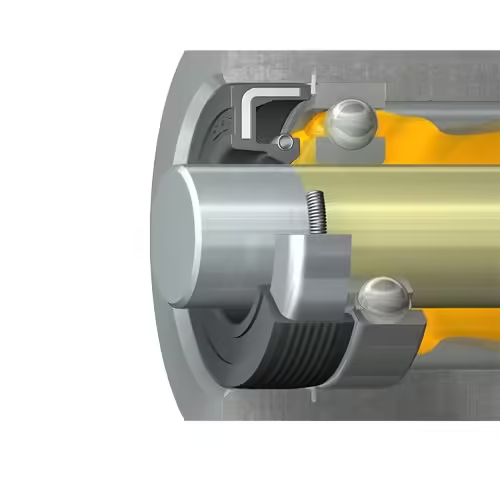
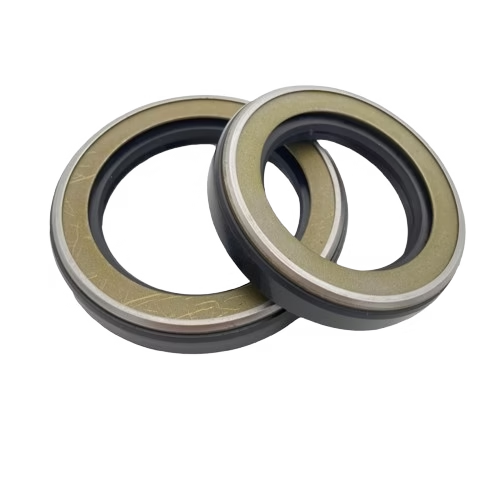
An oil seal, also known as a rotary shaft seal or radial lip seal, is designed to keep lubricants inside equipment while preventing dust, water, and external contaminants from entering the sealing system.
Oil seals are widely used in:
- gearboxes
- pumps
- motors
- reducers
- automotive transmissions
- agricultural machinery
- hydraulic and rotary equipment
A properly selected oil seal helps maintain lubrication, protect bearings, reduce wear, and extend equipment life. A poorly selected one can fail early even if the installation is correct.
Why Accurate Oil Seal Measurement Matters
When an oil seal needs replacement, many users simply measure the old seal and reorder the same size. That works in some cases, but not always.
An oil seal may have:
- worn lips
- hardened rubber
- deformation after long service
- damaged spring
- faded or incomplete markings
That means the removed seal is not always the most reliable reference. If the size is measured incorrectly, the replacement may fit loosely in the housing, grip the shaft improperly, or fail prematurely after startup.
For buyers, this creates several risks:
- repeated oil leakage
- unnecessary maintenance cost
- production downtime
- extra shipping cost for replacement parts
- loss of confidence in the supplier
That is why correct oil seal measurement should be treated as part of the purchasing decision, not just a maintenance step.
The Three Main Dimensions of an Oil Seal
Most standard oil seals are identified by three basic dimensions:
ID × OD × Width
For example:
40 × 62 × 10 mm
usually means:
- 40 mm ID = shaft size
- 62 mm OD = housing bore size
- 10 mm Width = seal thickness
Inner Diameter (ID)
The inner diameter refers to the nominal shaft size the seal is designed for.
This is important: the actual sealing lip is normally slightly smaller than the shaft in its free state. This is intentional. The lip must create interference on the shaft surface to maintain sealing contact.
So when identifying a seal, buyers should not assume the relaxed inner lip measurement equals the exact shaft size.
Outer Diameter (OD)
The outer diameter is the dimension that fits into the housing bore.
A correct OD is essential for proper sealing between the seal outside surface and the housing. If the OD is too small, the seal may loosen or leak around the outside diameter. If it is too large, installation becomes difficult and the seal may deform.
Width
Width is the axial thickness of the oil seal.
This dimension affects installation space and seal positioning inside the housing. A wrong width may cause misalignment, insufficient retention, or lip position problems relative to the shaft running surface.
Oil Seal Dimensions Quick Reference Table
| Dimension | Meaning | Where It Fits | Why It Matters |
|---|---|---|---|
| ID | Inner Diameter | Shaft | Determines sealing contact on the shaft |
| OD | Outer Diameter | Housing bore | Ensures secure fit in the housing |
| Width | Seal thickness | Axial installation space | Affects positioning and fit |
How to Measure an Oil Seal Correctly
Tools You Should Use
For accurate measurement, use:
- vernier caliper
- micrometer
- clean flat working surface
- good lighting
- reference drawing if available
For procurement or OEM confirmation, it is even better to measure the shaft and housing directly, not only the old seal.
Step 1 — Measure the Shaft Diameter
The most reliable way to identify oil seal ID is to measure the shaft diameter itself.
Why? Because the nominal seal ID is based on shaft size, not on the relaxed lip opening of a used seal.
Best practice:
- clean the shaft surface
- measure at multiple positions
- check for wear grooves or scoring
- confirm whether the shaft is still within tolerance
If the shaft is worn, ordering the same seal size may not solve the leakage problem.
Step 2 — Measure the Housing Bore
Measure the housing bore where the oil seal is pressed in.
This confirms the required OD of the oil seal.
Best practice:
- clean the bore thoroughly
- measure at several points
- check for ovality, wear, or damage
- confirm whether the housing is still suitable for standard press fit
In many failure cases, leakage is caused not by the seal lip, but by poor fit between the seal OD and the housing.
Step 3 — Measure the Seal Width
Use the caliper to measure the overall thickness of the seal body.
This dimension may look simple, but it is important because width affects:
- installation depth
- lip running position
- space clearance
- replacement compatibility
If the shaft has a wear track, changing width slightly may sometimes help move the lip to a fresh running surface.
Step 4 — Check Seal Type and Structure
Size alone is not enough. Two oil seals can have the same dimensions but different structures.
You should also identify:
- single lip or double lip
- with spring or without spring
- metal case or rubber covered
- pressure type or standard type
- rotary application or static exclusion design
This step is often ignored, but it matters a lot in replacement purchasing.
How to Read Oil Seal Markings
Many oil seals have markings printed or molded on the face.
A typical marking may look like:
40 62 10 NBR TC
This usually indicates:
- 40 = shaft size / nominal ID
- 62 = OD / housing bore
- 10 = width
- NBR = material
- TC = seal design type
However, markings may fade after service, especially in hot, oily, or dirty environments. In those cases, visual inspection and direct measurement become necessary.
How to Identify Oil Seal Type
For industrial buyers, one common mistake is focusing only on dimensions while ignoring design type.
Common oil seal structure differences
Single lip oil seal
Used in standard lubrication sealing applications where dust exclusion is limited.
Double lip oil seal
Includes an additional dust lip to help keep contaminants out. Often used in dirty environments.
Spring-loaded oil seal
Uses a garter spring to maintain lip force on the shaft. Common in dynamic oil sealing.
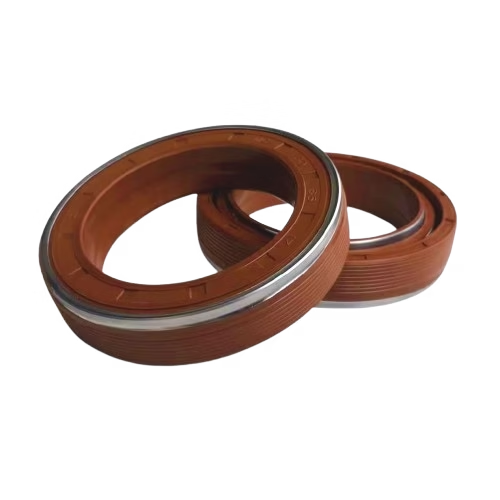
ubber covered OD
Improves sealing in housings with minor surface imperfections.
Metal OD
Often preferred in rigid housings and some standard industrial designs.
If the original seal is TC type and the buyer replaces it with a different structure only based on size, the result may be poor sealing performance even though the dimensions seem correct.
Common Oil Seal Materials and When to Use Them
Material selection is just as important as size.
NBR (Nitrile Rubber)
Typical temperature range: -40°C to +120°C
NBR is the standard material for most general-purpose oil seals. It offers good resistance to mineral oils, grease, and common industrial lubricants at a reasonable cost.
Best for:
- gearboxes
- pumps
- motors
- standard industrial machinery
Main advantage: low cost and reliable general performance
Main limitation: limited resistance to high heat and aggressive chemicals
FKM (Fluoroelastomer / Viton®)
Typical temperature range: -20°C to +200°C
FKM is used for higher-temperature and chemically demanding environments. It performs better than NBR in hot oil, fuel, and aggressive media.
Best for:
- automotive transmissions
- engine systems
- high-temperature rotary equipment
- chemical or harsh oil environments
Main advantage: better heat and chemical resistance
Main limitation: higher cost
PTFE
Typical temperature range: about -60°C to +260°C depending on design
PTFE is often used in high-speed or chemically aggressive environments where elastomer seals may wear or degrade too quickly.
Best for:
- high-speed shafts
- chemical processing equipment
- dry-running or marginal lubrication conditions
Main advantage: low friction and excellent chemical resistance
Main limitation: higher cost and more demanding hardware requirements
Oil Seal Material Comparison Table
| Material | Temp Range | Oil Resistance | Chemical Resistance | Wear Resistance | Cost Level | Typical Use |
|---|---|---|---|---|---|---|
| NBR | -40°C to 120°C | Good | Moderate | Good | Low | General industrial oil sealing |
| FKM | -20°C to 200°C | Excellent | Excellent | Good | High | High-temperature and harsh media |
| PTFE | -60°C to 260°C | Excellent | Excellent | Very good in proper design | High | High-speed and chemical applications |
Cost vs Performance — What Should Buyers Choose?
For most standard applications, NBR delivers the best cost-performance ratio. It is widely available, economical, and suitable for large-volume industrial use.
However, if the seal operates in high heat, synthetic oils, fuel, or aggressive chemicals, upgrading to FKM may reduce leakage risk and extend service life enough to justify the higher initial cost.
For highly demanding applications, PTFE may be the better engineering choice, especially when shaft speed or media compatibility is a bigger issue than initial seal price.
Practical purchasing logic:
- choose NBR for standard oil sealing and budget-sensitive projects
- choose FKM when temperature and media are more demanding
- choose PTFE when speed, friction, or chemical resistance is critical
The right choice is not the cheapest seal. It is the seal that gives the lowest total cost over its service life.
Common Mistakes When Measuring and Ordering Oil Seals
Measuring the old seal only
A used seal may be worn, hardened, shrunk, or deformed. Measuring only the removed part can lead to repeat mistakes.
Assuming lip ID equals shaft size
The sealing lip is designed with interference. Buyers should confirm the shaft diameter instead of relying only on the lip opening.
Ignoring housing condition
Even a correct OD will not seal properly if the housing bore is damaged, oversized, or worn.
Ignoring seal type
Two seals with the same dimensions can perform very differently if one is single lip and the other is double lip, or if one includes a garter spring and the other does not.
Ignoring material compatibility
A correctly sized seal can still fail quickly if the material is incompatible with temperature, oil, fuel, or chemicals.
Real-World Application Examples
Gearbox oil seal replacement
In a standard industrial gearbox using mineral oil, the most common replacement choice is an NBR spring-loaded rotary oil seal. Before ordering, buyers should confirm shaft diameter, housing bore, and width, then verify whether the operating temperature is still within NBR range.
Automotive transmission application
Transmission systems often run hotter and use more demanding fluids than ordinary gearboxes. In these cases, FKM is often preferred over NBR for longer service life.
Chemical pump application
In pumps exposed to aggressive media or high-speed shafts, buyers may need FKM or PTFE, not standard NBR. Size may be correct, but material failure can still cause rapid leakage.
Dusty agricultural equipment
For contaminated environments, a double lip oil seal is usually a better choice than a standard single lip seal because it provides additional exclusion against dirt and debris.
Buyer’s Checklist Before Ordering a Replacement Oil Seal
Before sending an inquiry or placing an order, confirm the following:
- shaft diameter
- housing bore size
- seal width
- seal type or cross-section
- spring-loaded or not
- single lip or double lip
- rubber covered or metal OD
- material type
- working temperature
- lubricant or media type
- shaft speed
- application environment
If possible, also provide:
- photos of the old seal
- equipment model
- application drawing
- operating conditions
- quantity demand
This helps the supplier recommend the correct replacement instead of only matching nominal dimensions.
How to Avoid Repeat Seal Failures
If an old seal has failed, do not assume the only problem was poor seal quality.
Check for:
- shaft wear groove
- excessive runout
- rough shaft finish
- housing damage
- incorrect installation depth
- wrong material selection
- pressure beyond standard seal capability
- contamination or poor lubrication
This is especially important for OEM buyers and maintenance teams. Reordering the same seal without checking failure cause may only repeat the same problem.
Conclusion
Measuring and identifying an oil seal correctly requires more than reading the dimensions on an old part. A reliable replacement depends on shaft size, housing bore, width, seal structure, material, and working conditions.
For standard replacement work, the basic rule is simple: confirm ID, OD, and width, then verify seal type and material before ordering. For more demanding applications, buyers should also consider shaft condition, temperature, lubricant compatibility, and contamination risk.
In industrial purchasing, the most successful oil seal replacement is not just the one that fits. It is the one that seals reliably, lasts longer, and reduces the total cost of maintenance.
Email: [email protected]
Website: drorubber.com
WhatsApp: +0086 15815831911
WeChat: +0086 13784044874
Country: China